
Our first engine sounded 8-bit
Seat Time is our browser driving sim at AI Maker Lab, built with AI coding agents. Its engine passed our loudness and seam checks. Then we listened on production and called it “very artificial and 8-bit like”.
We wanted it to sound like a car. On October 2, 2026, that meant changing the source, after fixing the mix. By the end of the same day, recorded engines had become the default.
Previously: Chasing “sim-grade”: rebuilding the tyre.
We measured the synth before touching it
The first engine was synthesized, with a turbo whistle and blow-off sound layered over it. Before replacing anything, we had the agents build a repeatable audio test harness. Two runs differed by no more than 0.00002 dB. That steadiness let us compare changes without wondering whether the test itself had drifted.
The harness found faults worth fixing. The Tempest mix clipped at +0.6 dBTP, a true-peak level above digital full scale. At a held high engine speed, the turbo exceeded the engine tone by 3.8 dB in the 1–8 kHz band. The limiter also changed its behaviour with the rendering frame rate. A car's audio shouldn't depend on how quickly its picture redraws.
The agents tackled each cause separately: mixer levels, turbo balance, tyre switching thresholds and the limiter's clock. They gave the blow-off sound a 5 ms attack instead of an abrupt start. They moved the limiter onto the audio clock and set a −5.7 dB headroom adjustment. The defaults ended up about 5–7 dB quieter.
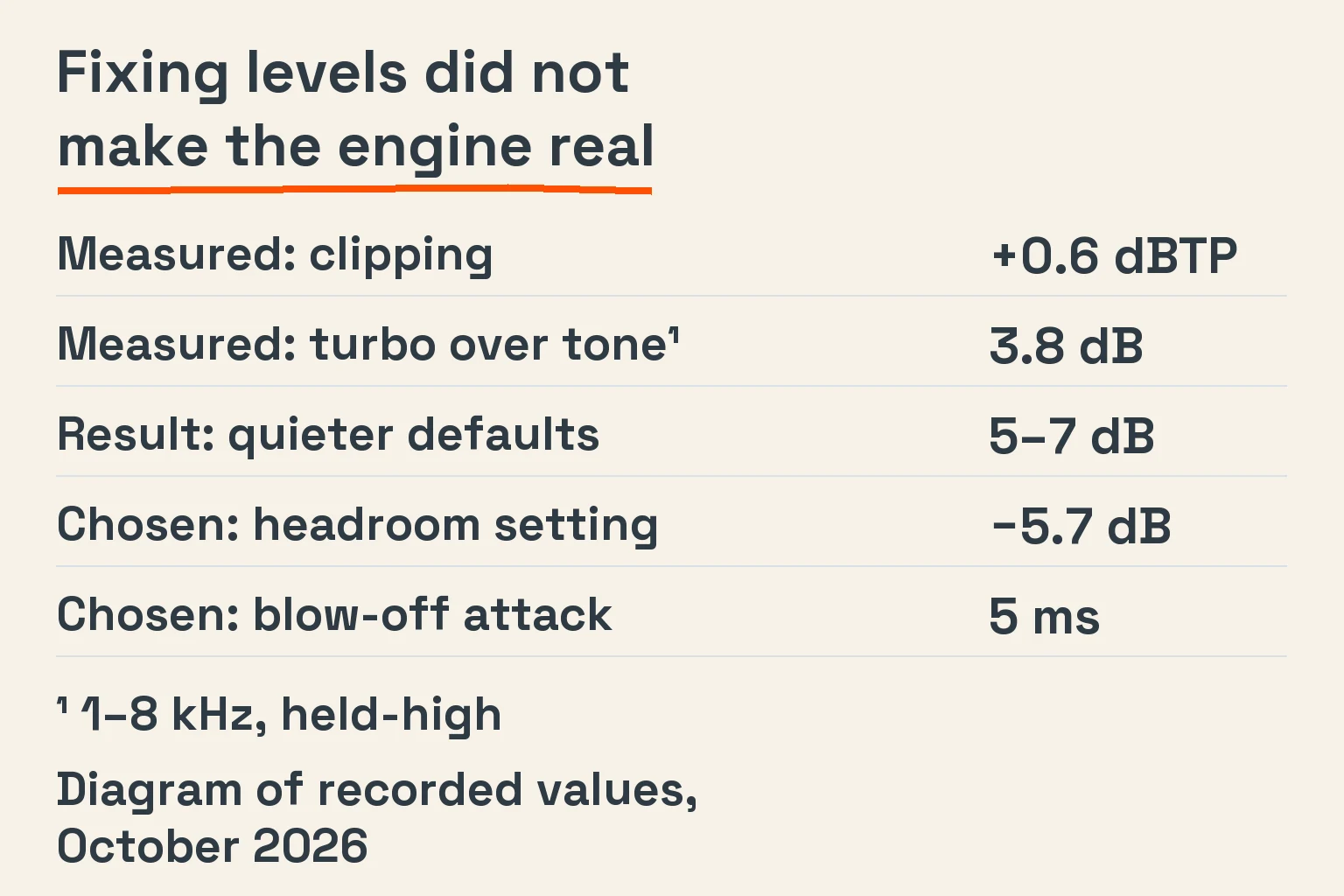
Those fixes mattered. They removed specific mix problems without settling the question we actually cared about: did this sound like an engine? True-peak measurement, described in ITU-R BS.1770, cannot answer that listening question.
Our first samples were the synth in disguise
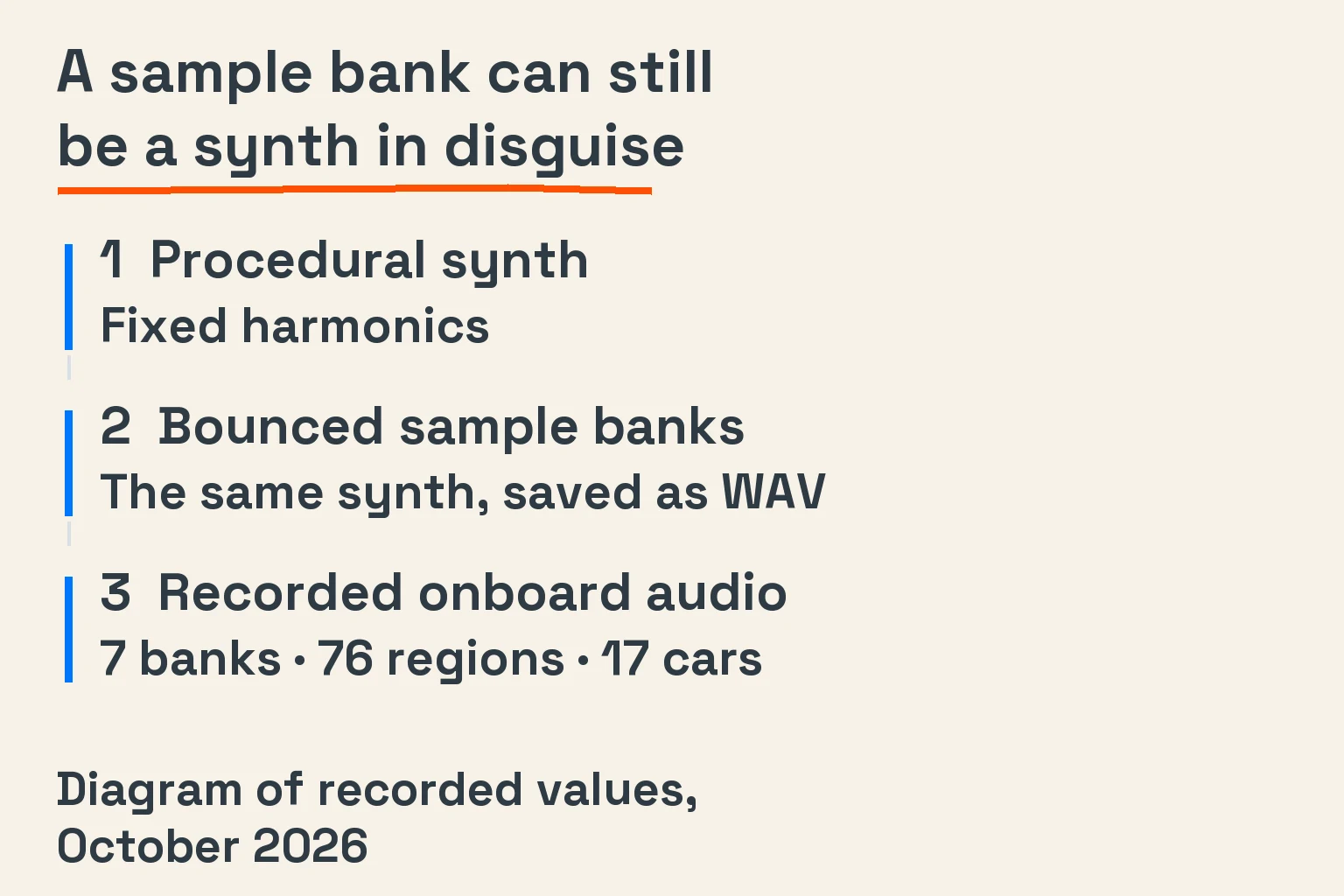
The first attempt at sampled audio changed the playback machinery, but kept the same source. The recordings we wanted were in the Sonniss GDC game audio bundle. The official torrents returned a forbidden response during our download attempts. So the agents exported our own synth into audio files and built banks from those instead.
Even those banks needed work. An equal-power crossfade—a blend intended to maintain power between sounds—left a 1.22 dB dip at boundaries. The agents replaced it with a phase-preserving linear blend. The default engine still remained procedural at that stage.
Our production listening verdict cut through that progress: “very artificial and 8-bit like”. Underneath, the source was still a fixed-harmonic PeriodicWave. MDN describes PeriodicWave as a periodic waveform used to shape an oscillator. Ours supplied a repeating harmonic recipe; exporting it into files didn't give it a recorded engine's character.
Downloads failed, so we brought the files
Real recordings finally changed what went into the banks. The agents' next download attempts hit a gateway timeout and a quota limit. We supplied the nine official bundle parts locally that same day. That unglamorous handoff let the audio work continue.
The agents cut onboard recordings into seven banks, containing 76 regions, and mapped all 17 cars to them. These were the counts on October 2, 2026, not a description of every later bank revision. Recorded playback became the default.
Cutting a bank meant finding usable stretches of engine speed. An offline pitch tracker compared repeating patterns in the waveform using autocorrelation. A Viterbi path then selected a consistent pitch sequence, removing octave flips. The tool sought regions within ±2% of a target engine speed and made 1–2 s loops containing whole firing periods.
Blending real recordings exposed another problem. Linear and equal-power blends left 2–6 dB holes between regions. The agents used a four-voice, covariance-normalised crossfade instead. It adjusted the blend using how the overlapping signals varied together. The recorded banks needed a different solution from the synth exports.
We turned the fake turbo off
The synthetic turbo layer now got in the recordings' way. Comparing the isolated layers showed that the whistle and blow-off added 8–13 dB of masking high-band energy. We disabled both over the recorded banks. Adding more sound had been hiding the source we'd just worked to obtain.
The whole reversal happened within a day. About 16.4 hours separated the first merged audio fixes from the recorded-engine change. That is elapsed development history, not a claim about labour saved by the agents.
The licence record travels with the sound
The recordings came with rights and restrictions, not ownership of the original takes. Our provenance record tracks each region back to its source and supplier, including Pole Position Production. We kept that record alongside the game audio.
The Sonniss bundle licence allows editing and royalty-free use within finished projects. It prohibits supplying the recordings as standalone sound effects and using them to develop, train or enhance artificial-intelligence technologies without express permission. Copyright remains with the respective holders. Using coding agents to implement our player does not turn the recordings into our original work.
We haven't embedded comparison audio here. We have no retained historical clips or spectrograms suitable for this account, and the clip-licensing question remains unresolved. The figures explain recorded values; they aren't reconstructed listening evidence.
Tyres and cockpit wind came later
Later work added recorded tyre scrub, surface and contact sounds, and airflow inside the cockpit. Sustained squeal proved awkward: the recorded tone around 2 kHz was piercing, so the sustained loop was dropped. Short squeal events remained in that work. Earlier wind had been synthetic; exterior wind deliberately stayed synthetic even after recorded cockpit airflow arrived.
That later package also included generated rain from Stable Audio and squeals cleaned with Meta SAM-Audio. The record leaves the output-terms and model-licence checks unresolved. We therefore describe those assets as part of the work, without claiming they were cleared for release.
Gemini supplied an automated listening screen, but its opinions weren't our acceptance. The later package was explicitly “not yet heard in a live drive”. That unfinished listen belongs in the story alongside the implementation.
The source became our next constraint
In the build documented for this article, recorded banks are fixed as the engine model. The synth remains a fallback; there isn't a user-facing synth-versus-recorded switch. Better source material gave us a different problem to work on, rather than a final verdict that every car sounded right.
Drive any car in Seat Time with Settings → Sound at defaults.
Next we needed places worth driving through: Building places to drive.
Notes and sources
First-party measurements — Our retained build records report the repeatability, clipping, turbo balance, quieter defaults, crossfade dips and masking-energy comparisons above. These are historical harness results, not a new listening test or independent certification. The figures are diagrams of those records.
Chosen design values — The blow-off attack, headroom adjustment, pitch-selection window, loop lengths and four-voice blend describe implementation choices. The bank, region and car counts describe the recorded-engine cutover on October 2, 2026. The elapsed time comes from that day's integration timestamps.
Our listening verdict and interpretation — “Very artificial and 8-bit like” is our recorded reaction on production. The repeating-source explanation is our interpretation of that implementation. No car or route was preserved with the reaction, so we haven't supplied one. AI coding agents built the harness and processing tools; this article was also written with AI assistance.
Sourced facts and credits — MDN: PeriodicWave explains the browser waveform interface. ITU-R BS.1770 covers loudness and true-peak algorithms; EBU R 128 gives related loudness and maximum-level guidance. These references explain terminology, not certification of our game. Sonniss's bundle archive and licence describe the source collection and permitted uses. Pole Position Production is credited as a recording supplier. Names identify their respective products and rights holders, without implying endorsement.
Unfinished verification — The later tyre, surface and cockpit-wind package had an AI-model screen, not an accepted live drive. Licence checks for its generated rain and AI-cleaned squeals remain unresolved in the retained record. No audio assets are offered for download here.