
Why we started building a driving sim in a browser
In our browser driving sim, built at AI Maker Lab with AI coding agents, the road car caught the slide. Then it spun on the swing-back. That was the build of September 28, 2026, when we still called it Racing Sim. The game is now Seat Time, and that unresolved spin is where this journal starts. E2 E7
We wanted to drive a car, feel something wrong, and then point at the exact test that shows it. We started with three cars and a slide we couldn't reliably catch. Physics Lab gave us a place to run those tests and keep the failures visible. E1 E3
We wanted to drive it and test it in the same place
From the start, driving and checking the physics belonged to the same experiment. The game was where we drove. Physics Lab, next to it, ran the same procedures our automated tests use, with the same reference bands—the ranges a result must fall within to pass. So when a car felt off, we could turn "it feels weird" into a run with a car, settings and a number. E3
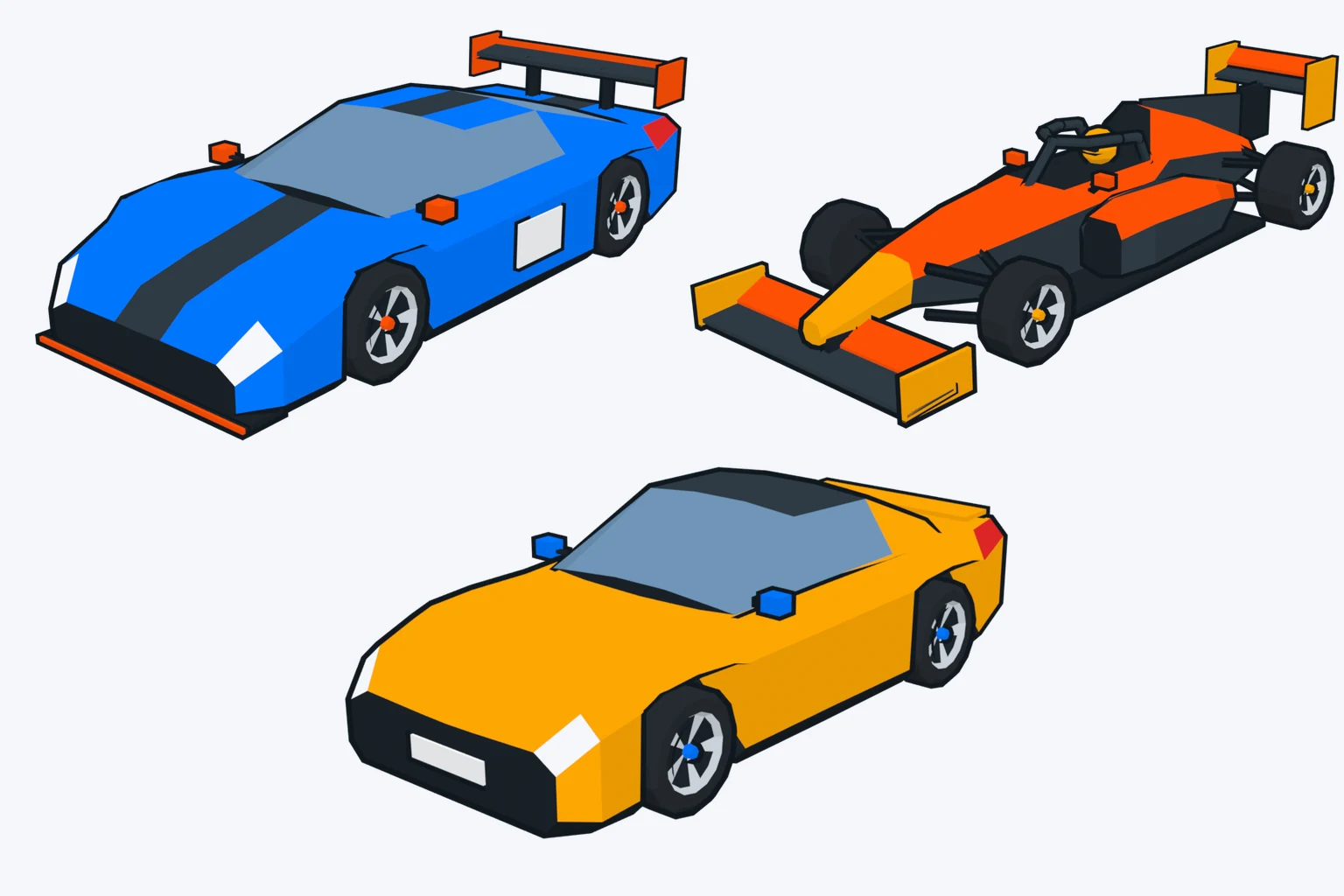
We began with three cars: a GT3 coupe, an open-wheel car and a road car. They shared one simulator, but not one set of tests. Only the GT3 had a top-speed reference band, for example. That taught us early that a car in the garage says less than a measured run and the conditions behind it. E3
Under the bonnet, forces move the car
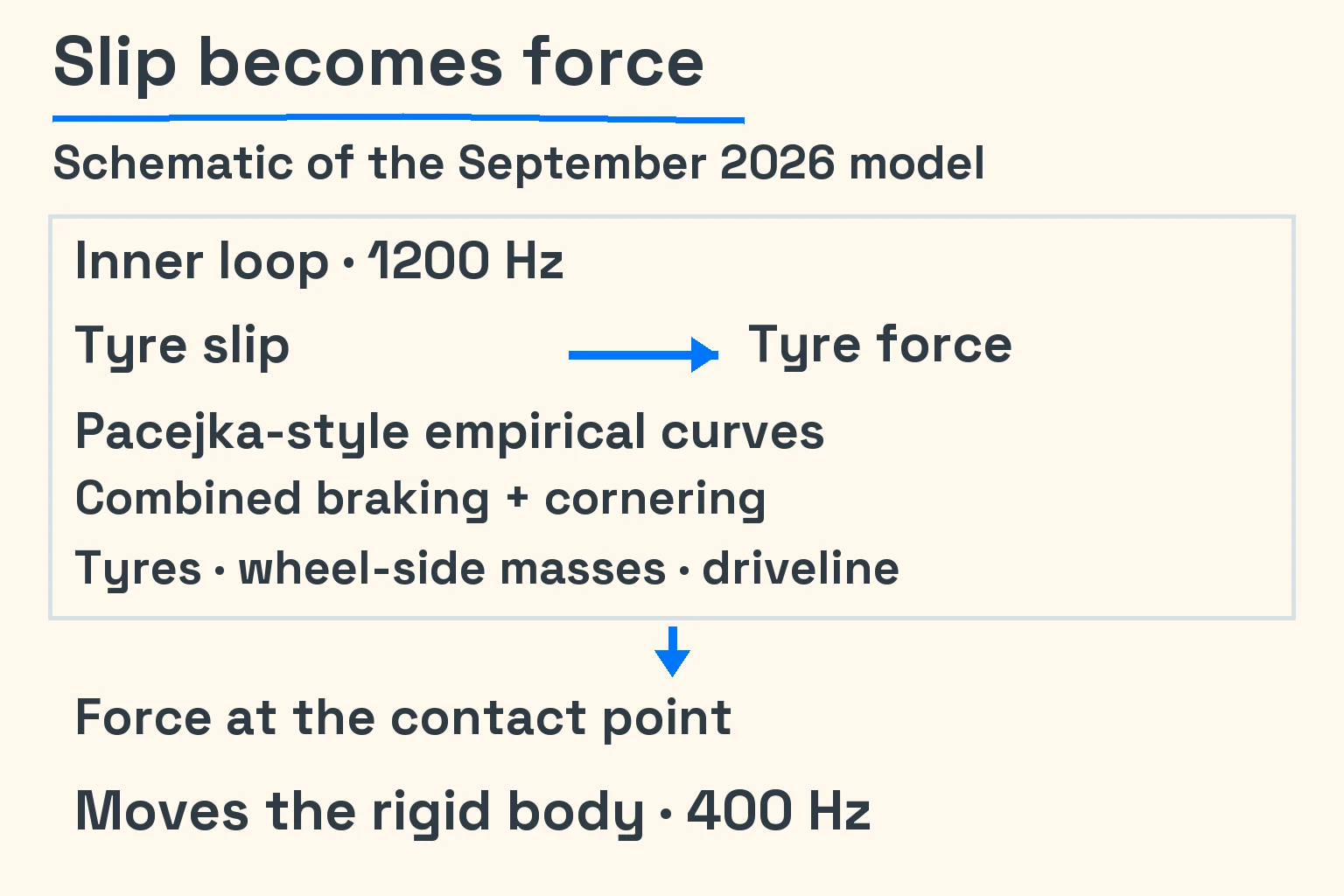
We wanted the car to move because of forces, not because a script told it where to go. The body ran at 400 Hz, with a 1200 Hz inner loop for tyres, wheels and driveline. Those are simulation update rates, not display frame rates. The tyres use Pacejka-style curves, which turn slip into force. They respond to braking and cornering together, to load, pressure and camber (the wheel's tilt against the road). E5 E6
Around the tyres we kept adding the things that change how they behave. Tyres heat up across the tread, wear, and pick up rubber from the track. Loose rubber, called marbles, costs grip off the racing line. Anti-lock braking and traction control step in. Brakes fade when they get hot. Aero reacts to ride height, and a hit on the barrier can bend the alignment or puncture a tyre. E5 E6
We also scored ourselves against the big desktop sims. Our own audit went from 2.31 to 3.25 out of 5. That was our judgment of how much of the model existed, not a measurement against any other game. The list of what was missing was more useful: no tyre data for a real car, no flexible chassis, and no force feedback—the torque a steering wheel sends to your hands. Keep that last one in mind for a later episode. E5 E6
The slide we kept losing
The complaint came from driving, not from a test. On the keyboard, the steering limit depended only on speed. So when a slide started, there wasn't enough counter-steer—steering against the slide—left to catch it. On top of that, the GT3's default traction control smothered what the throttle should do mid-slide. We changed the keyboard steering, dropped the GT3's traction control from level 3 to 2, and increased how far its front wheels could turn. E1
Then we found a second problem, the one that comes after you release the throttle. With the clutch engaged, the engine's inertia kept the rear wheels spinning, and that wheelspin reduced sideways grip in this case. We added a clutch control so the driver could break that link. On cold tyres, the GT3 now caught a slide in the browser without spinning. A later, harder catch still failed. We didn't call it fixed. E1
So we built a lab where failures stay visible
That's why we built Physics Lab. It had 18 experiments at the time. Each one shows the result next to its reference band, with a replay or a chart. If you change a setting after a run, the result is marked stale. If no band applies, the Lab says "no-band" and doesn't pretend. E3 E4
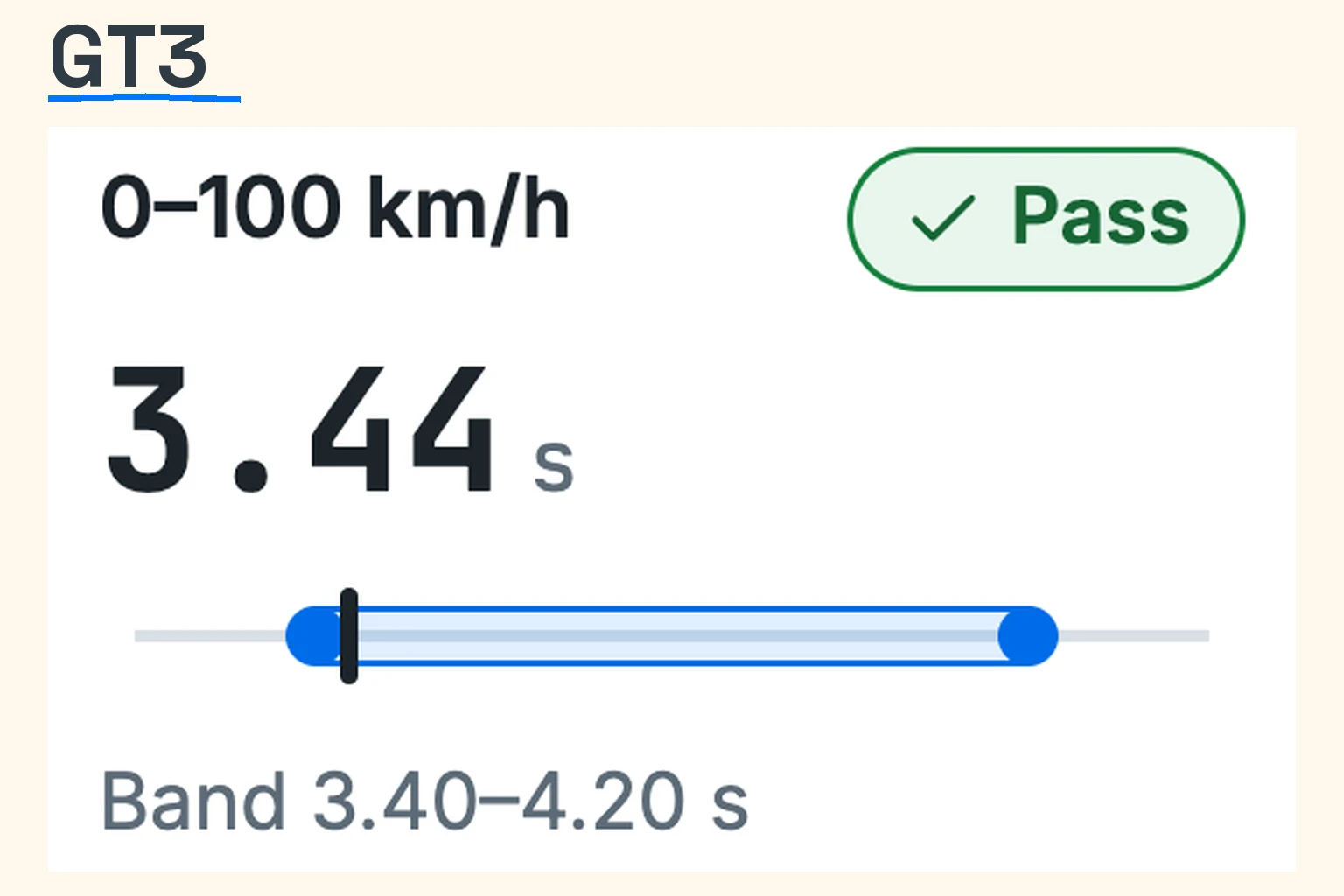
One run we liked: the GT3 reached 100 km/h in 3.44 seconds, inside its 3.4–4.2 second band. That run used tyres preset to 90 °C, so it isn't a cold-start promise. The Lab shows that setting right beside the number. E3 E4
The car still spins on the swing-back
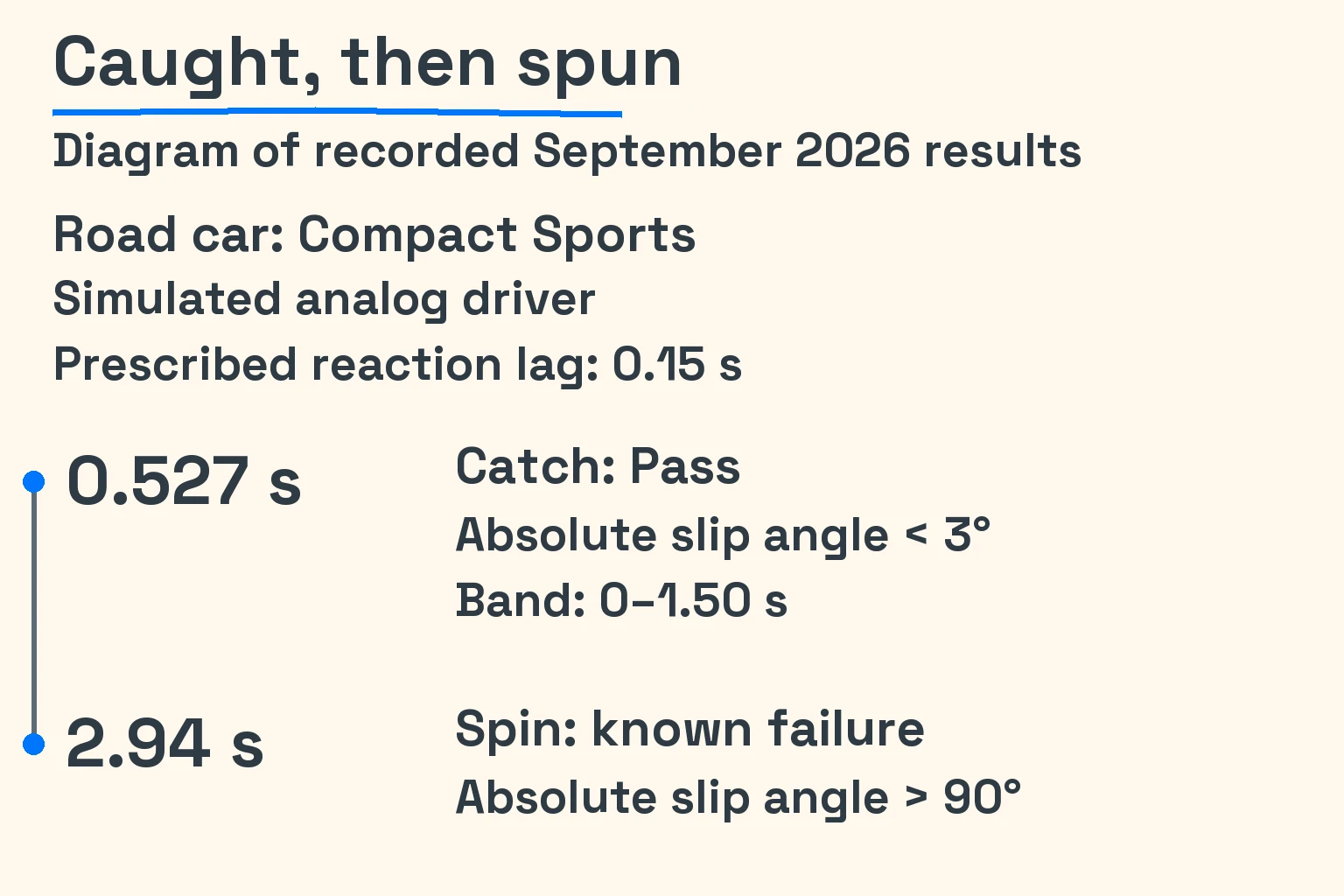
The road car catches the scripted slide, then spins as the rear swings back the other way. The simulated test driver has a prescribed 0.15-second reaction lag, not a measured human reaction time. It passes the catch-time check and fails the no-spin check. That failure remained unresolved. A simpler car model with the same lag also oscillated into a spin. Our guess is that the lagging driver is the cause, but that's still a guess. We tested single-parameter changes, not every combination. E2 E1
Two more things stayed open. The hardest cold-tyre GT3 catch still spins. Engine braking also looked low in our engineering report. The comparison value was unverified, and raising it broke the tyre warm-up band. We left it alone for now. E2 E1
What we want to try next
Next, we want to find out which half of the problem is ours to fix: the recovery driver, the car's physics, or both. The test would keep the same slide entry and check two things. The car shouldn't spin on the swing-back, and every other handling band should still pass. Before that, though, we had a bigger question to answer: how close to a real sim was any of this? E2
Drive the current Seat Time. This journal records the September build, not a fresh assessment of today’s game. Physics Lab requires sign-in and access permission; signing in alone is not a promise of access. E7
Next episode: Chasing “sim-grade” and rebuilding the tyre.
Notes and sources
AI coding agents wrote most of the code under our direction; AI also helped research, write and localize this article. These notes summarize saved excerpts from our engineering records for September 28, 2026, rather than the original reports. The full reports are not public. We did not rerun the tests or verify wheel hardware for this article. These records describe a historical local build, not independent validation or the state of today’s game.
E1 — Controls changed; one harder catch still failed
Recorded observations: the speed-only keyboard cap restricted counter-steer, and the GT3’s traction control suppressed throttle response during a slide. Chosen changes: traction control from level 3 to 2, more steering lock and a clutch control. The reported cold-tyre browser case recovered without spinning; a later, more severe catch still spun. The report also retained the engine-braking trade-off: an unverified comparison suggested it was low, but raising it broke the tyre warm-up band.
E2 — Catching and staying caught were separate tests
Measured in the retained report: the road car caught the slide at about 0.53 s, then spun at 2.94 s. The diagram preserves the historical display of 0.527 s, not extra precision or a new run. Chosen design values: a simulated analog driver with 0.15 s lag, catch below 3° absolute body-slip angle within 1.50 s, and spin above 90° within the four-second test. Body-slip angle means the angle between where the car points and where it travels. Our interpretation: driver lag deserved investigation because a separate simplified model also spun; individual changes did not rule out combined physics changes.
E3 — A result needed its conditions
Recorded implementation: 18 experiments, the same procedures and bands as the automated tests, and GT3, open-wheel and road cars. Only GT3 had a top-speed reference band. Chosen interface behavior: changing settings marked a result stale; an inapplicable reference produced “no-band.” The improvement button copied car, settings, metrics, bands and verdicts into a report; it did not automatically send it.
E4 — The warm-tyre acceleration run
Measured in the Lab report: GT3 0–100 km/h in 3.44 s, during “Run all” in headed Chrome on an Apple M1 Max using Metal. Chosen benchmark conditions: a 3.4–4.2 s band, tyres preset to 90 °C and a green track—a surface without accumulated rubber—at 0.96 grip. Passing applies to those conditions. It is not a cold-start or real-car performance guarantee.
E5 — Forces, with missing real-car data
Recorded architecture: 400 Hz body updates and a 1200 Hz inner loop, with empirical Pacejka-style slip-to-force curves. The audit describes combined braking and cornering, load, pressure, camber, heat, wear, track rubber, driving aids, brake fade, ride-height-sensitive aerodynamics and impact damage. It still lacked real-car tyre and manufacturer data, chassis flex and wheel torque output. Sourced background: MathWorks’ Magic Formula documentation describes an empirical equation relating longitudinal tyre force to slip. Hans Pacejka’s Tire and Vehicle Dynamics, third edition is a book reference, with a public publisher listing rather than free full text. Neither source validates our implementation or its results.
E6 — Our score, not a simulator ranking
Our interpretation: 2.31 → 3.25 out of 5 was the corrected audit’s judgment of model structure. Its reference bar was iRacing, rFactor 2, Le Mans Ultimate, Assetto Corsa Competizione, Assetto Corsa EVO and Automobilista 2. We ran no matched cross-simulator test. The score established neither parity nor real-car accuracy.
E7 — The name changed; this record stays in September
Sourced fact: the public game page, read on November 6, 2026, identifies Seat Time. It does not verify the old measurements or whether those failures still occur. The retained November access review found the Lab unavailable anonymously and requiring sign-in plus access permission. We did not repeat that access check or establish who can enter. The next experiment described above remains a proposal, not a scheduled fix.