
How to Edit AI Drafts: Fix Evidence Before Style
Imagine opening an AI-assisted draft and removing its bold text and em dashes first. Only afterward do you open the citations. One source is broken; another does not support the claim beside it.
Material AI and automation helped research, transcribe, illustrate, translate, and review this article. I own and build AI Maker Lab, and I take responsibility for the final wording and source checks.
Check evidence before you edit the style
Start by checking whether every claim, citation, and editorial choice survives inspection before polishing the prose. A style-first review can make unsupported material sound convincing while leaving its integrity problems untouched.
The frozen Wikipedia field guide describes potential signs, not rules or proof of authorship. It also warns that some Wikipedia-specific signs may not transfer to other kinds of writing.
Style tells are clues, not verdicts
Style tells deserve attention, but they cannot decide who wrote a passage. Human writing can share the same patterns, so use them as review prompts rather than detector rules.
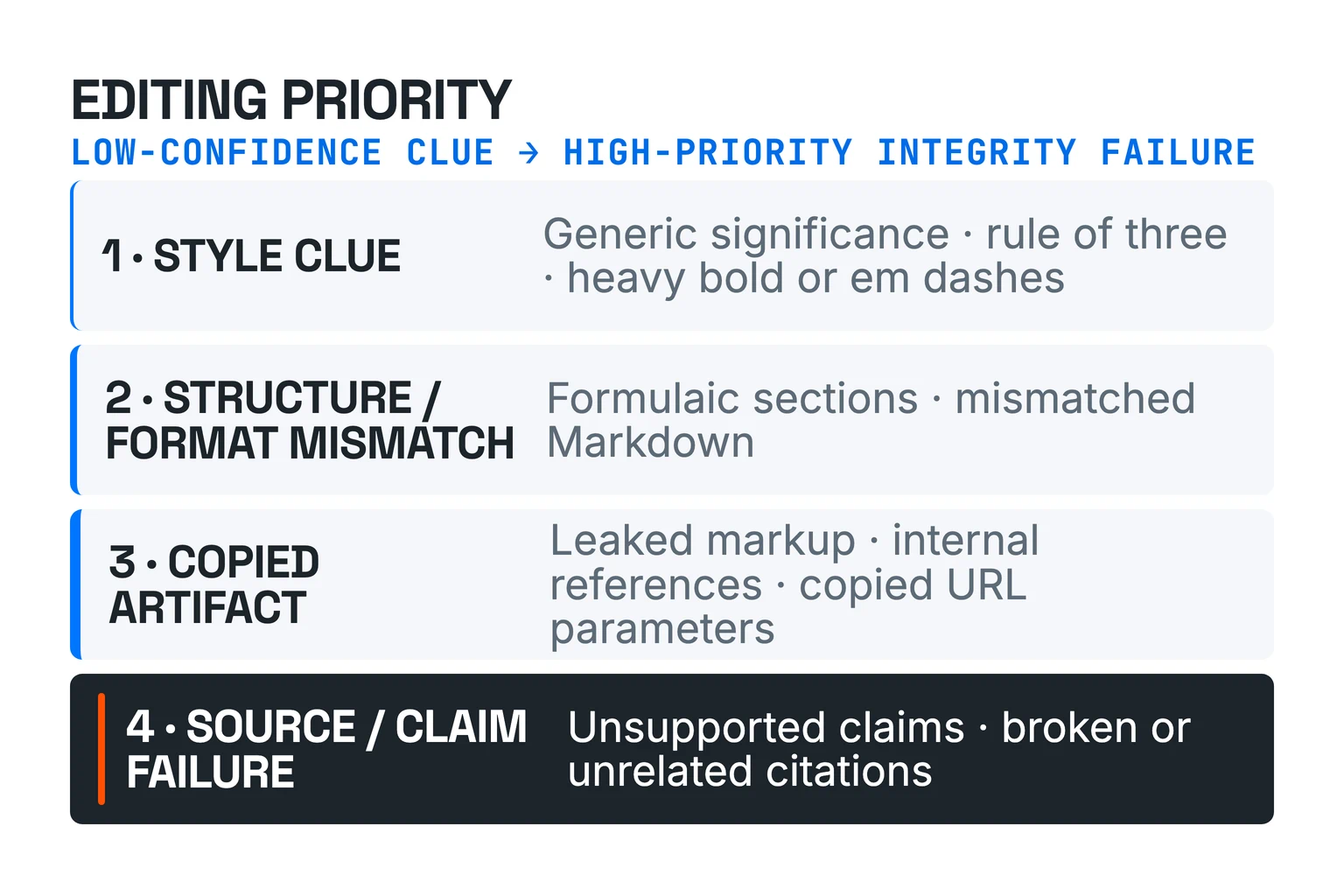
The Wikipedia field guide names generic significance, superficial analysis, rule-of-three phrasing, heavy boldface, frequent em dashes, and formulaic sections. Each example is bounded by the page’s descriptive caveat.
Ask whether a sentence adds topic-specific information or merely sounds important. Check whether repeated triples, emphasis, or predictable sections clarify the material. Keep useful choices; revise only the choices that weaken meaning, consistency, or fit.
Source failures matter more than tone
Integrity failures deserve earlier attention because they can invalidate an article even when its tone sounds natural. The Wikipedia field guide separates visible quirks from deeper problems carrying more serious policy risks.
In the video at 02:36, the speaker orders the signs as style, structure, formatting, residue, then sources. At 10:16, he calls source breakdown the greatest practical harm in that hierarchy.
The Wikipedia markup and citation sections cover leaked Markdown or wikitext, internal reference placeholders, and broken syntax. Copied parameters such as utm_source=chatgpt.com expose a link’s path, not proof about the surrounding prose.
Open every citation instead of trusting its title or identifier. A source may be missing, broken, or unrelated to the nearby claim. A real link still fails when it does not support the sentence beside it.
Review AI drafts in this order
Use the following five steps as AI Maker Lab’s source-first editorial synthesis. This sequence is not Wikipedia policy or the video’s verbatim hierarchy.
- Verify each claim against its source. Open the source, locate the support, and narrow unsupported wording.
- Inspect links, citations, and leaked markup. Test destinations, remove copied residue, and repair broken references.
- Replace generic filler with topic-specific facts. Preserve only details the approved evidence can support.
- Normalize voice and formatting. Align tone, emphasis, headings, lists, and punctuation after integrity checks pass.
- Explain consequential editorial choices. The writer or editor should justify important inclusions, omissions, and uncertainty.
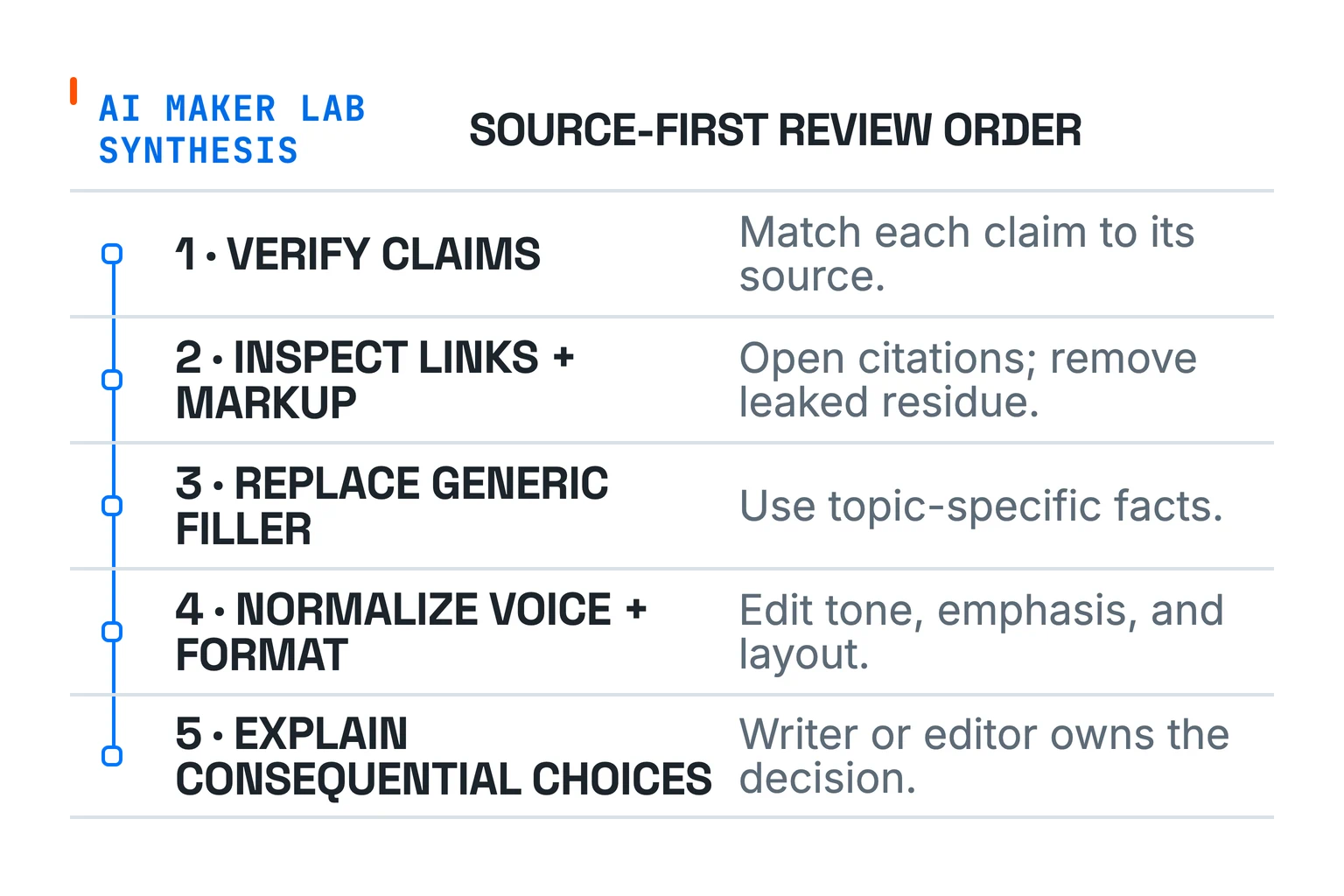
These steps neither detect AI nor guarantee quality. They put checkable integrity work before subjective polish and leave the final judgment with a person.
Human review means ownership
Human review means accepting responsibility for sources, uncertainty, and final wording rather than performing a cosmetic de-AI pass. The editor must understand why consequential choices remain in the article.
The speaker at 08:19 says using AI to write is not inherently wrong. Later, at 12:26, he frames double-checking, care for readers, and Human in the Loop as responsible practice.
That position belongs to the speaker; it is not a measured result or Wikipedia policy. Here, ownership means checking sources, stating limits, and defending the final language under your name.
Evidence before style is the practical distinction. Treat stylistic patterns as clues, fix source and claim failures first, then refine the prose.
Next, read When Blog Gates Pass but Prose Craft Drifts to connect this review order with the broader prose-craft gate.
Sources
- Wikipedia contributors. “Wikipedia:Signs of AI writing.” English Wikipedia, revision
1372013638, 2026-08-29 21:09:40 UTC. https://en.wikipedia.org/w/index.php?title=Wikipedia:Signs_of_AI_writing&oldid=1372013638. Accessed 2026-08-30. - まさおAIじっくり解説ch. “【AI臭い】Wikipedia公式が語るAI 文章が一発でバレる兆候5選!文章を作成する上で覚えておきたい解説.” YouTube, uploaded 2026-08-27, duration 17:10. https://www.youtube.com/watch?v=KbYcFhtg9CA. Complete corrected audio-derived Japanese transcript frozen 2026-08-30. Accessed 2026-08-30.
- AI Maker Lab editorial workflow. “Edit AI Drafts Better evidence-freeze record.” First-party observed workflow and editorial synthesis, 2026-08-30. Materialized as
S-AML-PRODUCTION-RECORDin the article evidence pack. Accessed 2026-08-30.