
Comparing Gemini, ChatGPT, and Claude's Jujutsu Kaisen Casts
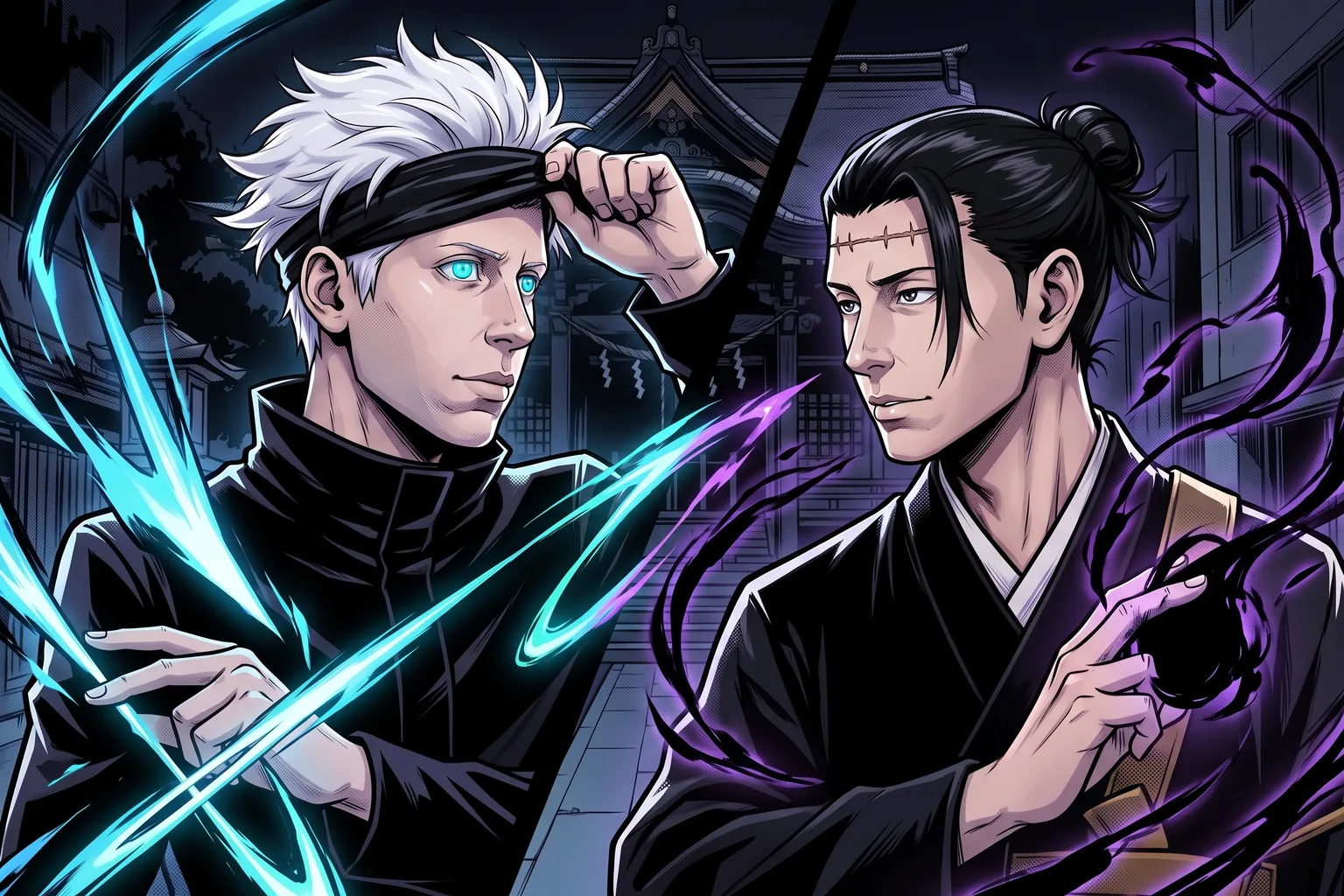
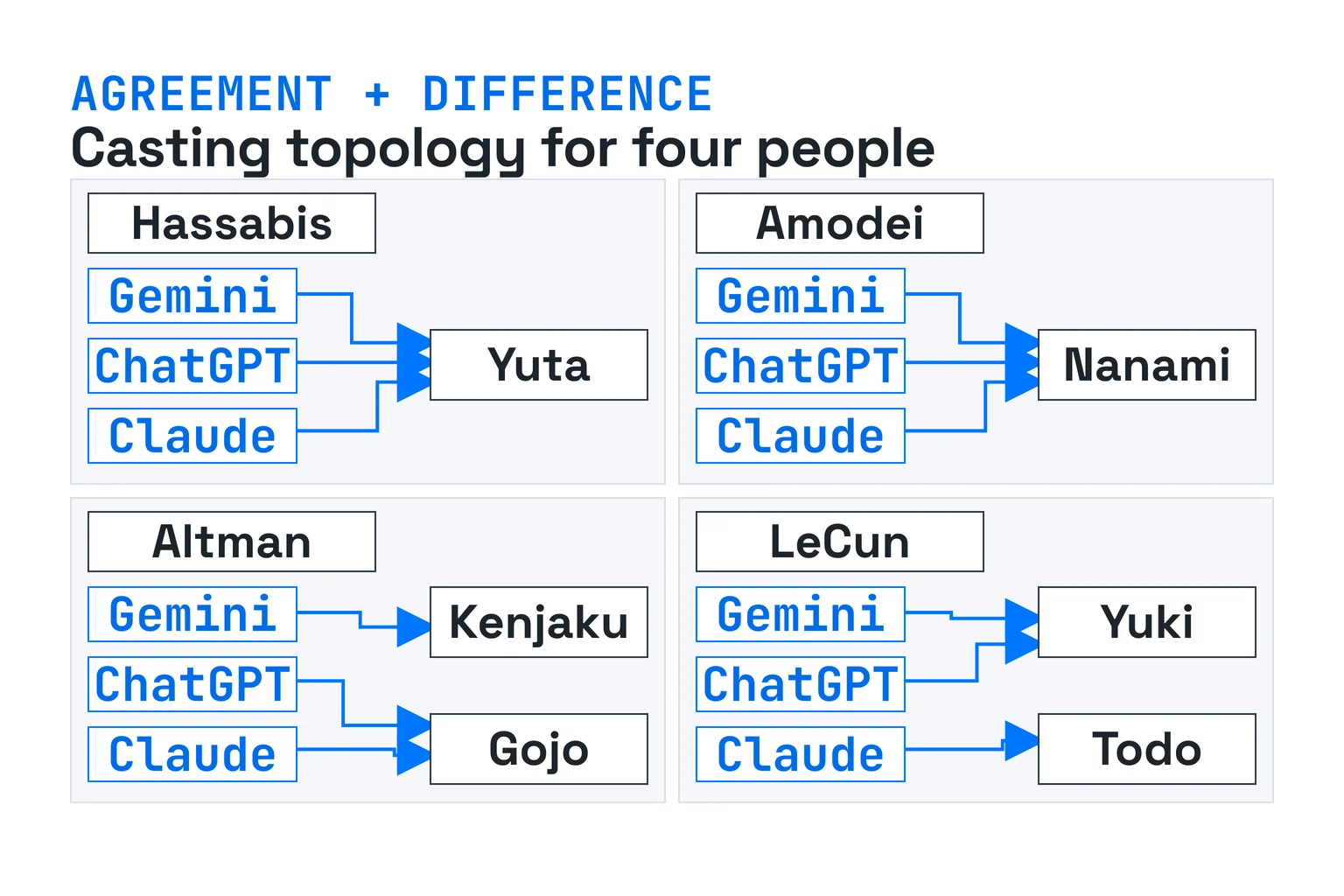
Layer the three casting lists and two patterns emerge: some rows converge from the same person on one character, while others branch toward two. Demis Hassabis → Yuta Okkotsu and Dario Amodei → Kento Nanami match across all three models. Sam Altman and Yann LeCun split 2–1.
AI and automation assisted with research, illustration, writing, and review; the operator of AI Maker Lab was responsible for the final wording and source checks. This comparison covers only the castings written in three outputs. It does not use a vote to determine anyone’s character or the “correct” answer.
The records being compared are the observed Gemini output, one Claude output, and the six ChatGPT pairings generated in this feature’s current session. The three models were not given the same candidate list under controlled conditions. Read this as a side-by-side comparison of the three lists we have.
What appears when all 10 people are placed side by side
The three lists contain 10 distinct people in total. Placing each model’s casting beside the others produces the following table.
| Person | Gemini | ChatGPT (current session) | Claude |
|---|---|---|---|
| Sam Altman | Kenjaku | Satoru Gojo | Satoru Gojo |
| Ilya Sutskever | Suguru Geto | Suguru Geto | — |
| Demis Hassabis | Yuta Okkotsu | Yuta Okkotsu | Yuta Okkotsu |
| Dario Amodei | Kento Nanami | Kento Nanami | Kento Nanami |
| Yann LeCun | Yuki Tsukumo | Yuki Tsukumo | Aoi Todo |
| Jensen Huang | Tengen | Tengen | — |
| Geoffrey Hinton | Yoshinobu Gakuganji / elder | — | — |
| Andrej Karpathy | Aoi Todo or Atsuya Kusakabe | — | — |
| Elon Musk | — | — | Ryomen Sukuna |
| Arthur Mensch | — | — | Maki Zenin |
Of the 30 cells in a 10-person × 3-model grid, 20 contain castings and 10 contain “—.” A dash means only that the person did not appear in the supplied list for that model.
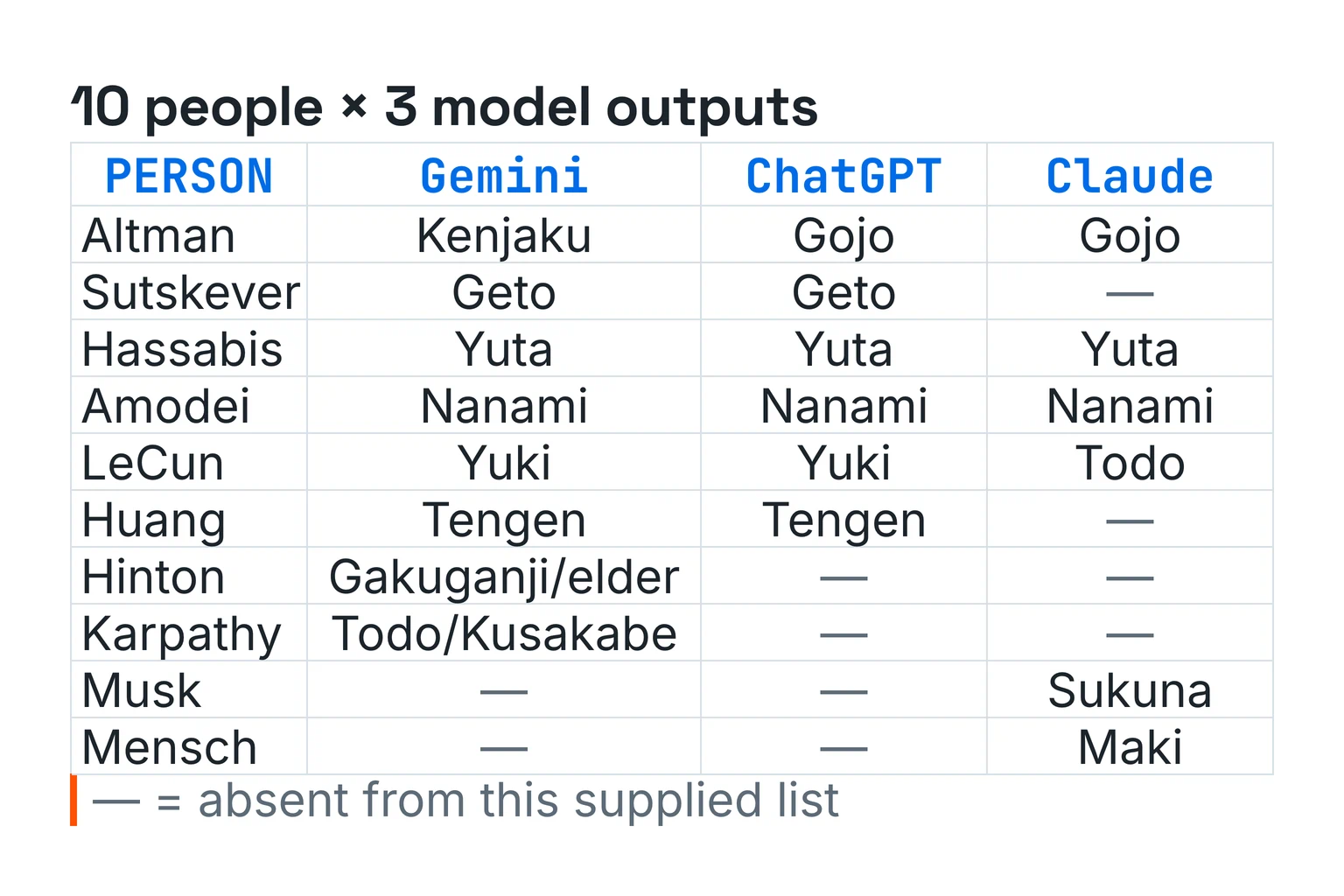
Gemini’s list has eight people; the current-session ChatGPT and Claude lists have six each. Because those totals differ, the empty cells reveal not only different character choices but also the outline of who each source list included. The list sizes are not scores for completeness or quality.
Only two pairings line up exactly
The two unanimous pairings are Demis Hassabis → Yuta Okkotsu and Dario Amodei → Kento Nanami.
When separate outputs are combined in one diagram, rows where three lines arrive at the same destination naturally stand out. Yet the only fact established here is that the character choice matches. We cannot say the models chose for the same reason, that the character resembles the person, or that the result is closer to correct.
The same three models arrange themselves differently for Sam and Yann
Sam Altman and Yann LeCun are the two 2–1 splits. For Sam, Gemini chose Kenjaku while ChatGPT and Claude chose Satoru Gojo. For Yann, Gemini and ChatGPT chose Yuki Tsukumo while Claude chose Aoi Todo.
Putting those two rows together reveals another difference. ChatGPT and Claude form the pair in Sam’s row, whereas Gemini and ChatGPT form the pair in Yann’s. Because the majority grouping changes, these two people alone do not support a claim that the same models always produce similar answers.
Nor does a casting with two votes become a winner, or the one-vote choice become wrong. The point is not a verdict, but the way the same three columns branch differently from one person to another.
Empty cells reveal the different candidate lists
Ilya Sutskever → Suguru Geto and Jensen Huang → Tengen match between Gemini and ChatGPT, while the Claude cells are empty. Both appear in the Gemini and ChatGPT lists, but not in Claude’s six-person list.
Elon Musk → Ryomen Sukuna and Arthur Mensch → Maki Zenin appear only in Claude’s list. Geoffrey Hinton → Yoshinobu Gakuganji / elder and Andrej Karpathy → Aoi Todo or Atsuya Kusakabe appear only in Gemini’s. Karpathy’s row preserves Gemini’s two alternatives rather than choosing one.
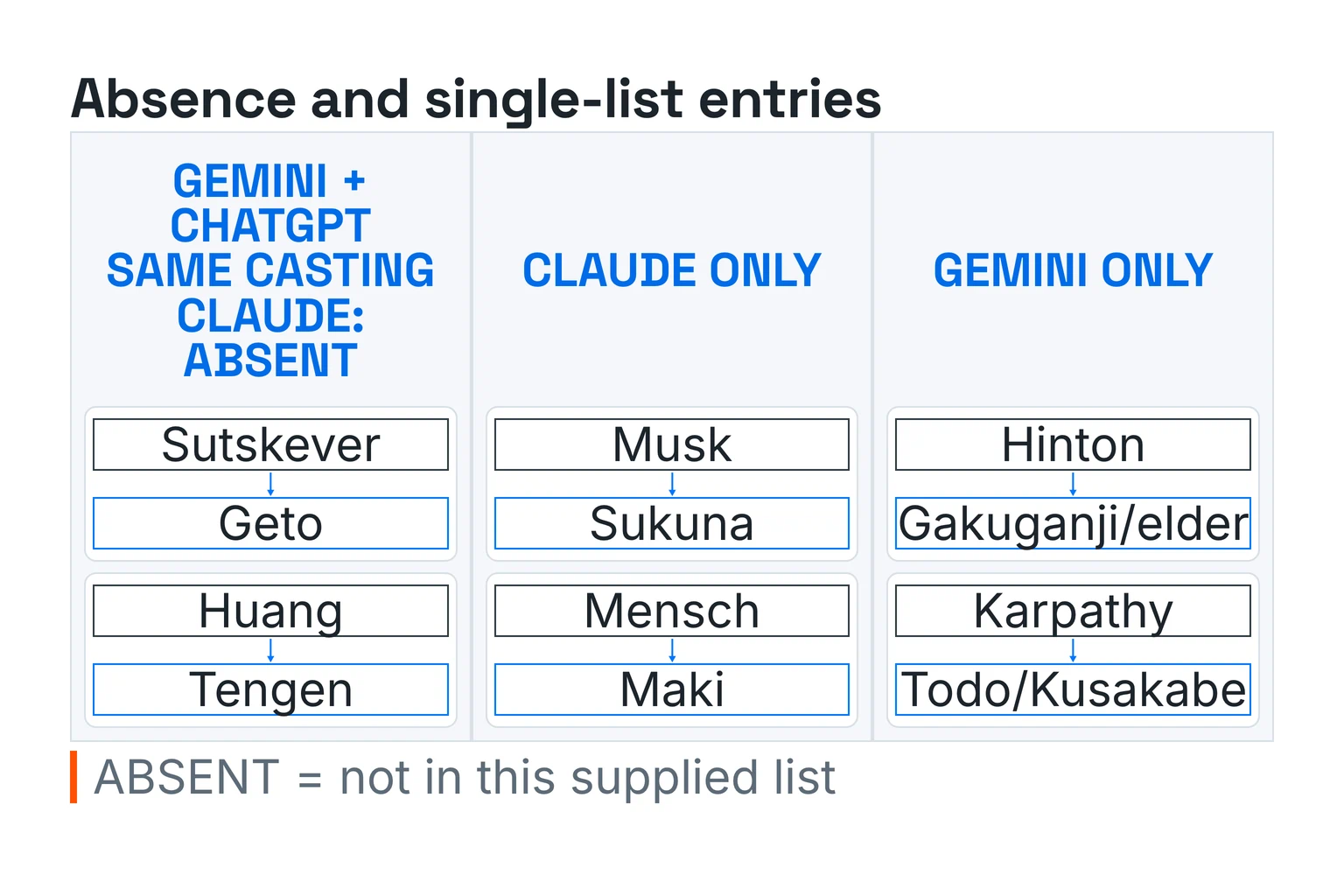
These differences did not result from giving the three models the same candidate list. An absence therefore cannot be read as refusal, lack of support, or a low rating. The empty cells show only that the source lists covered different people.
The comparison stops at these three records
For Gemini, this article uses only the output observed at the linked record. For Claude, it uses one conversation in which Claude proposed switching from people to labs, then answered with six pairings framed mostly by role labels after the request was repeated. That sequence is not generalized into a tendency of Claude as a whole.
The ChatGPT column does not recreate an older conversation. The older prompt was observable, but the answer text could not be observed reliably. The six entries in the table were generated and frozen in the current session for this feature.
The table can therefore show agreement, divergence, and coverage among three records produced under different conditions. It is not a ranking of the models’ personalities or performance.
In summary: the branching is more interesting than the consensus
Across the three lists, two pairings were unanimous, two people split 2–1, two people appeared in two models’ lists but not the third, and four appeared in only one list. More than the majority result, the interesting part is how the model groupings change by person—and how even the candidate coverage differs.
Read the individual articles:
- Read Gemini's cast on its own
- Read ChatGPT's current-session cast on its own
- Read Claude's role-label cast on its own
Finally, choose one of the 10 people and invent a different casting from all three models as an entertainment prompt.
Sources and scope
The primary sources below confirm only roles, research, and events. They do not substantiate character matches or fictional Cursed Technique, Domain, or Barrier names. AI output can be wrong. Jujutsu Kaisen and its characters belong to their respective rights holders; this article is not an official project, endorsement, or affiliation.
Observed model outputs
- Gemini (observed output only): https://aistudio.google.com/prompts/1dvAXsE59-WM2rtmA8DczUhmsnPTvuXYh
- Claude (output and response sequence observed in one conversation): https://claude.ai/chat/c7428ede-926d-4a9c-97cb-33f61aa0368f
- Older ChatGPT conversation (the prompt was observed, but the answer text was not used in this comparison): https://chatgpt.com/c/6a95ff9c-d36c-83e9-9e87-a0dfe64d0e8c. The ChatGPT castings in the table are current-session output.
Primary sources for fact-checking
- Sam Altman / return as OpenAI CEO: https://openai.com/index/sam-altman-returns-as-ceo-openai-has-a-new-initial-board/
- Sam Altman / return to the board: https://openai.com/index/review-completed-altman-brockman-to-continue-to-lead-openai/
- Ilya Sutskever / role at OpenAI: https://openai.com/index/introducing-superalignment/
- Safe Superintelligence Inc.: https://ssi.inc/
- Demis Hassabis / Google DeepMind, Nobel Prize, and AlphaFold: https://deepmind.google/blog/demis-hassabis-john-jumper-awarded-nobel-prize-in-chemistry/
- Dario Amodei / role at Anthropic: https://www.anthropic.com/news/opening-our-tokyo-office
- Anthropic / Constitutional AI: https://www.anthropic.com/research/constitutional-ai-harmlessness-from-ai-feedback
- Elon Musk / role at xAI: https://x.ai/news/onegov
- Arthur Mensch / role at Mistral AI: https://mistral.ai/about/
- Yann LeCun / world models and JEPA: https://ai.meta.com/blog/yann-lecun-advances-in-ai-research/
- Yann LeCun / V-JEPA: https://ai.meta.com/blog/v-jepa-yann-lecun-ai-model-video-joint-embedding-predictive-architecture/
- Jensen Huang / NVIDIA and GPU context: https://www.nvidia.com/en-eu/about-nvidia/governance/management-team/jensen-huang/
- Geoffrey Hinton / 2024 Nobel Prize in Physics: https://www.nobelprize.org/prizes/physics/2024/summary/
- Andrej Karpathy /
llm.c: https://github.com/karpathy/llm.c - Andrej Karpathy / Zero to Hero: https://karpathy.ai/zero-to-hero.html