
Storytelling Basics for Marketing Reels
A usable marketing Reel story has one character, one concrete goal, and one constraint that forces a choice. Show the resulting change with visible proof, then state what remains limited. Without that causal chain, polished clips can become a list of updates.
This guide covers the story between the opening and the close. Use the localized Reel hook guide for the opening promise. This article does not repeat its hook formulas or packaging checks.
AI Maker Lab builds Fortalece.ai and uses HyperFrames in its production workflow. The first-party example below evaluates our own records and artifacts, not independent products. No source in this article is a Reel performance study.
Use one character, one goal, and qualitative stakes
Start with one identifiable actor pursuing one concrete result. The character may be a creator, engineer, customer, team, or product operator. “We worked on localization” names a topic. “The AML team wanted each localized hook composition to be inspectable” gives one actor and a testable goal.
Keep the stakes honest and qualitative unless you have measurements. State what becomes unclear, unavailable, or harder if the goal fails. Do not convert discomfort into invented reach, retention, revenue, or time-loss claims. “Reviewers could not inspect the implementation” is bounded. “This story will improve retention” needs evidence this article does not have.
Conflict is not a louder description of the stakes. It is a real constraint that blocks the goal and forces a choice. Oklahoma State University Libraries’ film-textbook chapter defines narrative as causally related events. It explains that character goals create causal links, while opposing aims or material circumstances delay or prevent those goals (Uhlin, “Narrative”). This is educational narrative guidance, not Instagram evidence.
Use this planning order:
- Character: Who makes the decision?
- Goal: What concrete state do they want?
- Stake: What remains unclear or unavailable if they fail?
- Constraint: What real condition blocks the direct route?
- Choice: What do they do because of that constraint?
- Proof: What visible artifact shows the changed state?
- Limit: What does the proof still not establish?
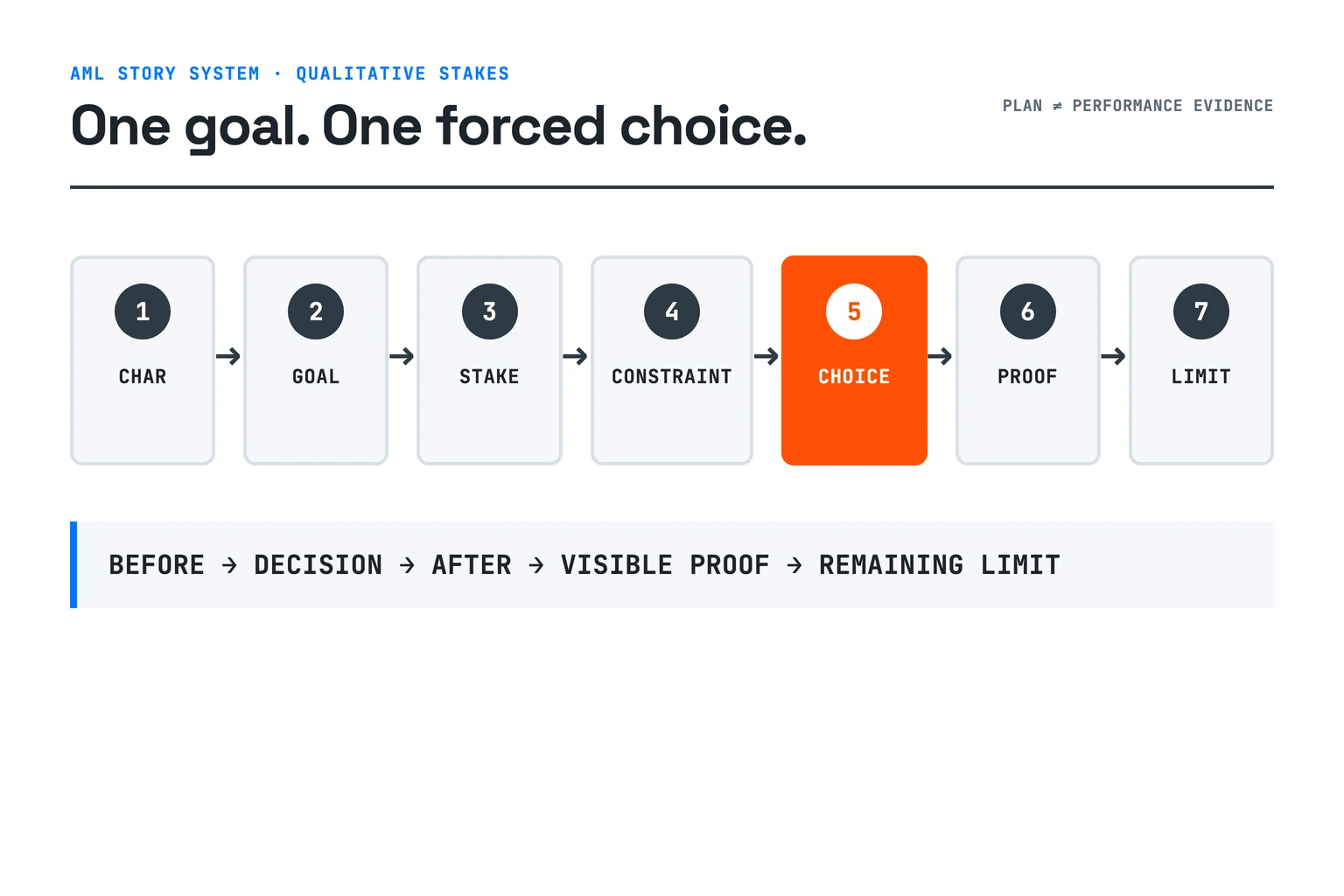
Figure key: 1 character, 2 goal, 3 stake, 4 constraint, 5 choice, 6 proof, 7 remaining limit.
Connect beats with but, because, and therefore
A story needs causal links, not just chronological order. Chen and Bornstein’s 2024 review describes narratives as networks of causally connected events. It reviews evidence that causal structure shapes narrative comprehension and memory, while identifying open questions about the underlying processes (Chen and Bornstein, 2024). The review does not test Reels or predict marketing outcomes.
MIT’s Communication Lab presents And–But–Therefore (ABT) as educational craft guidance. The structure connects known context, a gap, and an attempted resolution (MIT CEE Communication Lab). AML uses that limited structure here. We exclude the page’s unsupported retention-multiplier sentence.
We wanted localized compositions to be inspectable, but prose only described them. Because a reviewer could not examine implementation from prose, we produced standalone source and rendered artifacts. Therefore, the claim could point to inspectable files.
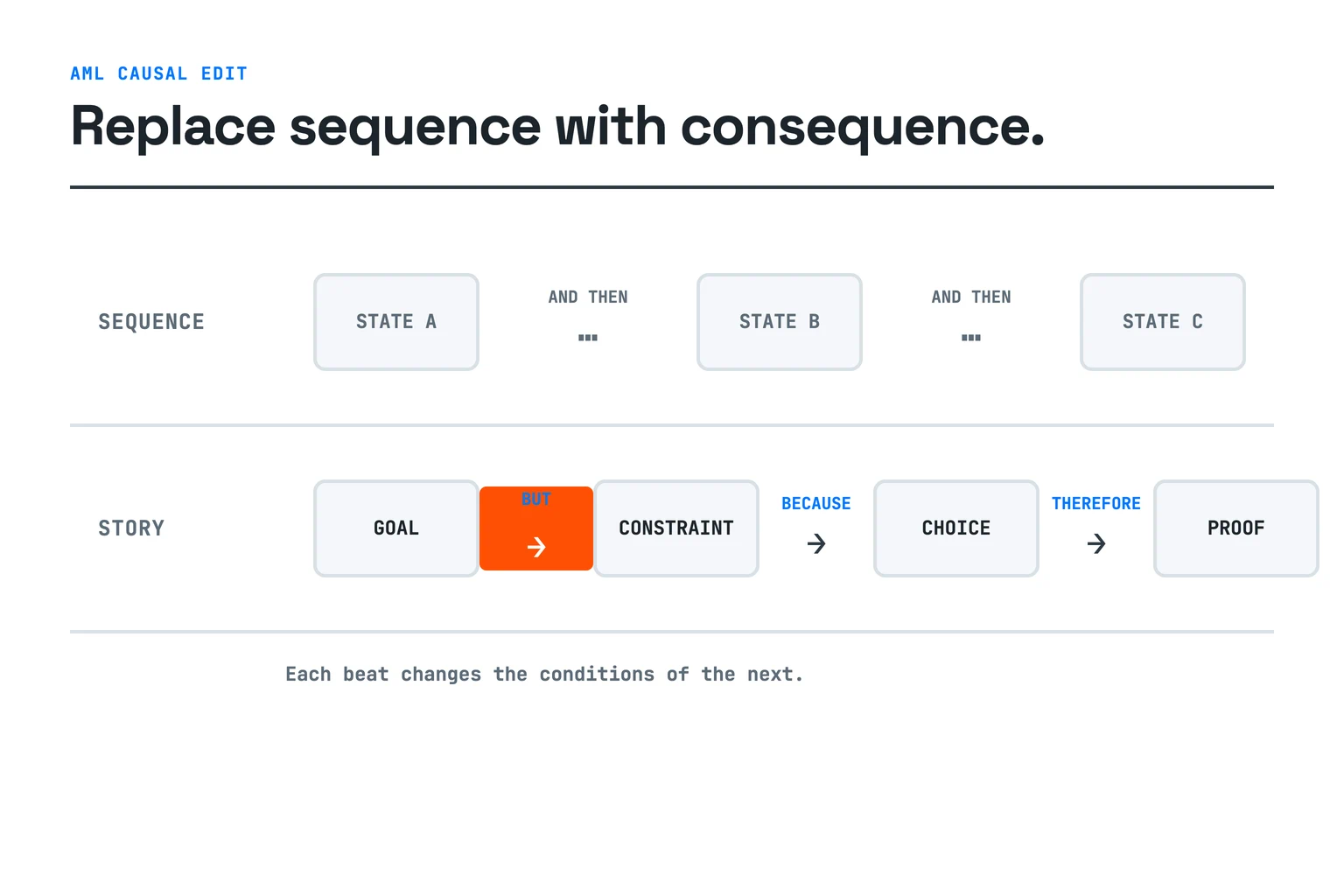
Figure key: state A, B, and C show chronology alone; goal, constraint, choice, and proof show the causal rewrite.
Show transformation as states, a decision, and proof
Transformation should be visible as before state → decision → after state → visible proof → remaining limit. An adjective such as “better” cannot carry this sequence. The viewer needs to see what existed, what changed, and which artifact supports the after state.
Treat the decision as the hinge. The character should not drift into a new state because time passed. The constraint should make the old route inadequate, and the decision should explain the new route. Then show a file, interface, comparison, test, or other observable object that supports the change.
The remaining limit completes the transformation instead of weakening it. Proof that source files exist does not prove platform compatibility. A completed render does not prove reach, retention, or conversion. Naming that boundary keeps the after state useful and specific.
Plan a 20-second or 30-second causal beat sheet
These timings are AI Maker Lab planning templates. They are chosen production values, not Meta guidance, experimental results, or universal cutoffs. Both durations assign the same six jobs; the 30-second version gives the constraint, decision, proof, and limit more room.
| Story job | 20-second plan | 30-second plan |
|---|---|---|
| Character, goal, and stake | 0–4s | 0–6s |
| Conflict | 4–7s | 6–11s |
| Decision and action | 7–12s | 11–18s |
| Proof and transformation | 12–16s | 18–24s |
| Honest limit | 16–17s | 24–27s |
| CTA | 17–20s | 27–30s |
The opening must establish the character’s current state and goal, not summarize the whole lesson. The conflict then closes the easy route. The decision consumes the largest share because it explains the work. Proof shows the resulting state. The limit qualifies that proof before one closing action.
See the system in one bounded AML example
The AML example changes from a formula description to editable source plus inspectable artifacts. The character is the AI Maker Lab team. The concrete goal was to make localized hook compositions inspectable. Prose alone described the formulas, but it did not expose their implementation. That constraint forced a choice: publish both source and rendered evidence.
The evidence-supported output is 18 standalone HTML compositions with corresponding silent 8-second 1080×1920 MP4 previews and WebP posters. The localized gallery of 18 HyperFrames Reel hook compositions exposes the article-facing set. Its production manifest records 18 HTML, 18 MP4, and 18 poster roles. The motion report records all MP4s as 240-frame, eight-second, 1080×1920 H.264 files with zero audio streams.
The transformation is specific: formula description → editable source plus inspectable artifacts. The limit is equally specific. These are not Instagram embeds or native Instagram templates. The records do not establish Instagram compatibility, browser compatibility beyond the inspected run, or any reach, retention, or conversion result.
The example follows the first-party AML craft rubric stored in Fortalece document da79dbd7-a0d6-41f1-a6fc-d7d1fe7ba133, revision 2, at marketing/research/instagram-reel-storytelling-anti-slop. Its repository mirror is docs/content/instagram-reel-storytelling-ai-slop-patterns.md. The rubric requires causal beats, real proof objects, and an honest remaining limit; it does not forecast performance.
Review the chain, then write one closing action
A final review should be able to answer five questions in order. Who wants what? What honest consequence makes the goal matter? Which real constraint blocks the easy route? What choice changes the state? Which proof shows the change, and what limit still applies?
If any answer is missing, repair the causal chain before adding polish. The story is complete when the proof answers the opening goal and the limit prevents overclaiming.
Turn one real constraint into one forced choice, then use the localized Reel script guide to draft the beats and close with one request.
Sources
- Janice Chen and Aaron M. Bornstein. “The causal structure and computational value of narratives.” Trends in Cognitive Sciences 28(8), 769–781, 2024. Review of narrative causality, not a Reel performance study. Accessed 2026-09-03.
- Graig Uhlin, Oklahoma State University Libraries. “Narrative.” Introduction to Film & TV, 2024. Educational film-narrative guidance, not Instagram evidence. Accessed 2026-09-03.
- MIT Civil and Environmental Engineering Communication Lab. “Scientific Storytelling: The ABT Method.” Educational craft guidance. AML uses only the And–But–Therefore structure and excludes the page’s unsupported retention-multiplier sentence. Accessed 2026-09-03.
- AI Maker Lab / Fortalece.ai. “Instagram Reel storytelling and AI-slop patterns.” First-party document
da79dbd7-a0d6-41f1-a6fc-d7d1fe7ba133, revision 2, pathmarketing/research/instagram-reel-storytelling-anti-slop; repository mirrordocs/content/instagram-reel-storytelling-ai-slop-patterns.md. - AI Maker Lab. “18 HyperFrames Instagram Reel Hook Templates to Download.” First-party template article and bounded artifact description, dated 2026-08-26.
- AI Maker Lab repository.
content/instagram-reel-hyperframes-templates/assets/video/artifact-manifest.jsonandcontent/instagram-reel-hyperframes-templates/assets/video/motion-report.md. Direct evidence for the 18 HTML, MP4, and WebP artifact families, dated 2026-08-26. - AI Maker Lab repository.
assets/illustrate/2026-09-03-storytelling-basics-for-marketing-reels-figures/. Deterministic HTML/CSS figure sources, render contract, and provenance for this article.