
When Blog Gates Pass but Prose Craft Drifts
I own and build this site, and I am evaluating this project’s own corpus, audit, guide, and content process. At commit 1edede9434f7911ef2a539222b5f836ecc6681ed, I audited 11 English posts. Four contracted dimensions—Sources, owner disclosure, figures, and title uniqueness—passed 11/11; ungated measures varied, and no gate gave reproducible pass/fail decisions. Material AI and automation helped produce this article. Agents grounded its context, materialized its evidence, and drafted its copy under human approval gates. Eight posts moved afterward, so affected values require re-measurement. The broader standard and every audit recommendation remain owner-review-pending, not adopted. The bounded, non-causal missing-gate interpretation motivates a proposed owner, operational contract, and recorded review pass.
Contracted dimensions held at the snapshot
At the audited commit, I measured all 11 posts. Every post had a ## Sources section, an owner disclosure, and at least one figure. I also found all 11 titles were unique. These are measurements and observations from the pinned snapshot, not claims about the later working tree.
I read that consistency as an ownership-and-contract pattern. I did not find a failure in the existing figure or claims controls. I found no comparable contract or pre-publish gate for the measured prose-craft dimensions.
Ungated prose measures varied by post
I measured variation across four ungated dimensions in the same historical snapshot. The figure below places those measurements beside the four contract-backed checks. Because eight posts moved afterward, every affected per-post value requires re-measurement before it is restated or used.
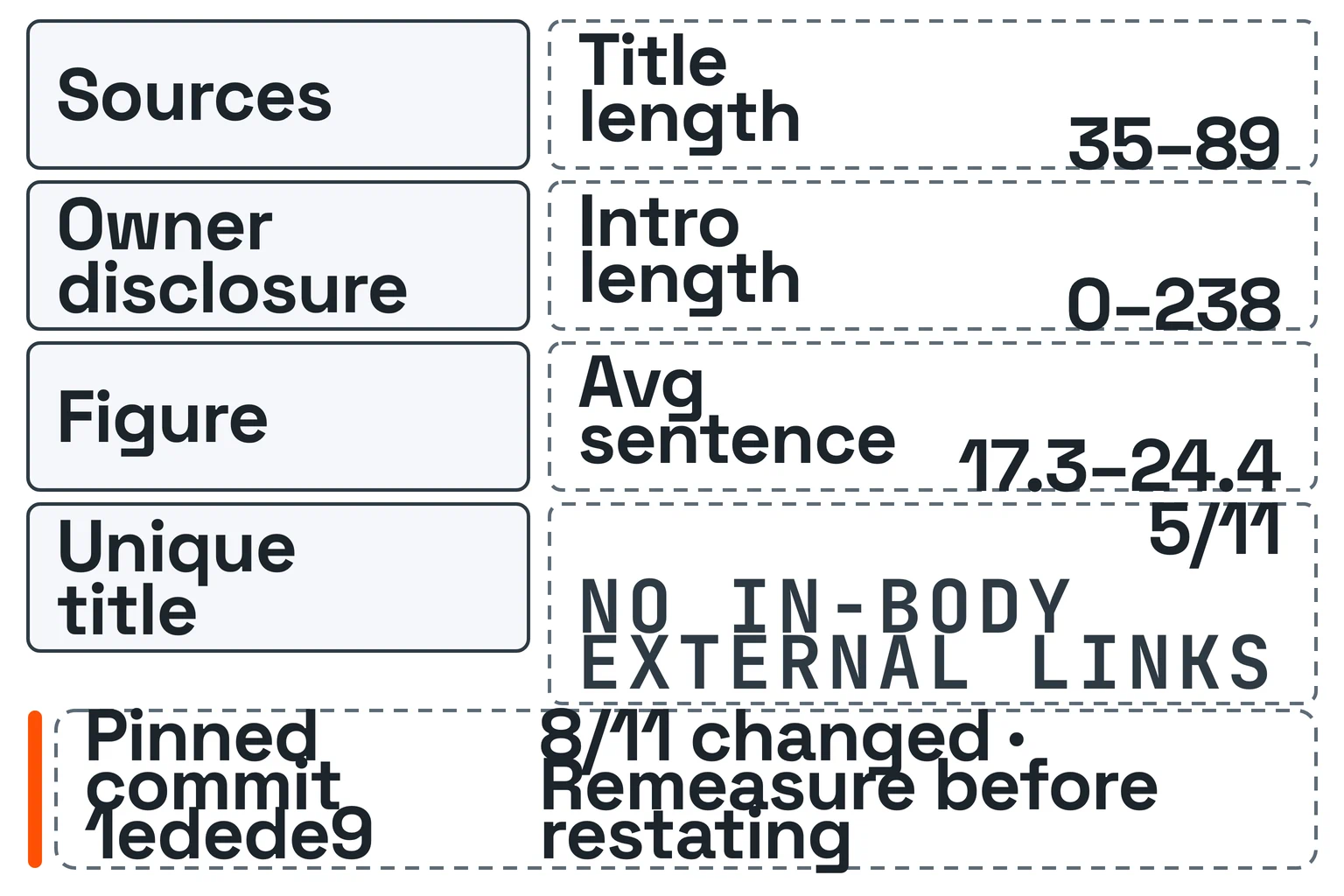
I also compared title lengths with Content Marketing Institute’s 60-character practitioner guidance for headlines. At the pinned commit, 9 of 11 titles exceeded that band. Google Search Central’s title-link guidance sets no title-length limit and says title links may truncate to device width.
Guide structure groups forty rows into five tiers
The standing Blog Writing Guide contains a cited structural count of 40 operational rows. Stable identifiers run from T0 through T4. The five tiers are unequal in size.
The tier counts are cited structural facts, not labels for every row’s source. T0 and T1 contain no house-convention rows. The guide cites NN/g’s inverted-pyramid guidance and Google Search Central’s people-first content guidance. It also cites Digital.gov’s plain-language guide series. Named house extensions include the problem-and-consequence hook and T4.6’s extraction convention.
Editing sequence proposes three separate passes
The proposed pre-publish sequence follows Grammarly’s practitioner editing guide. It uses three practitioner-sourced passes in a fixed order: substantive editing, copyediting, then proofreading. The guide requires a break between passes.
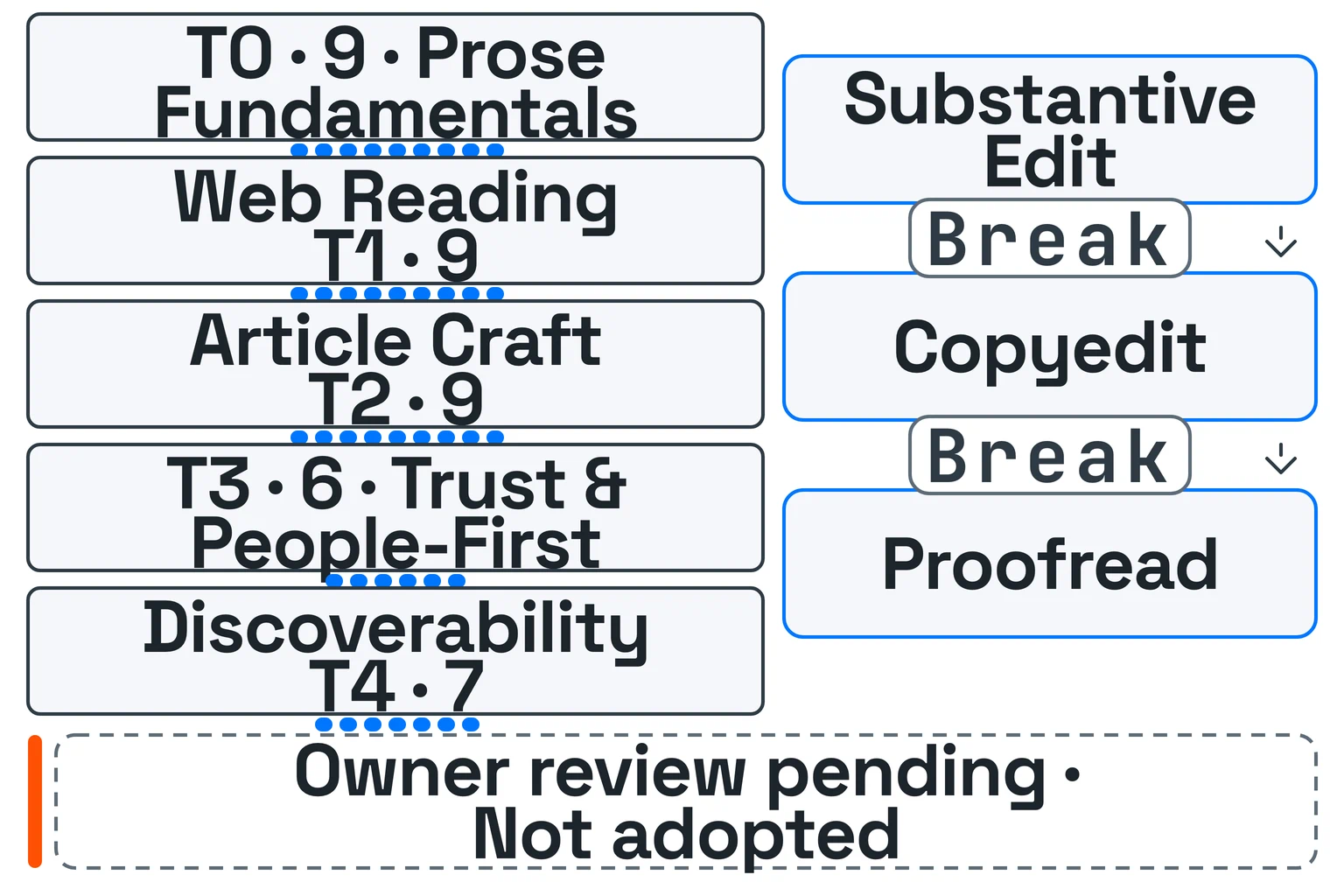
I found no repository record proving that this sequence ran on the measured posts. The sequence remains part of the owner-review-pending response. Every audit recommendation remains an unapproved proposal for human review. None authorizes editing a post.
Governance status separates the standing guide from the draft standard
The narrower Blog editorial style guide is published and approved at revision 2. The broader AML Blog Prose and Article Craft Standard is still a draft at revision 2. It remains owner-review-pending. Its status does not approve the audit, the proposed adoption, or any per-post fix.
Evidence labels separate measurements, citations, and interpretations
Evidence labels distinguish measurements of the 11 posts from cited structural facts and audit-author interpretations. The guide’s bibliography contains a cited count of 10 primary sources and 3 practitioner sources. I keep the 60-character band labeled as practitioner guidance and reserve house-convention labels for the named house extensions.
Ungated craft dimensions need an owner, a contract, and a review pass
Here, the missing gate left prose craft without a reproducible pass/fail decision. The proposed owner, operational contract, and three-pass review remain pending human review.
Read the related published article, The findability problem: the navigation rules I had to unlearn.
How to Edit AI Drafts: Fix Evidence Before StyleSources
- AI Maker Lab. “Gap report — blog prose craft was never gated.” First-party repository audit, observed 2026-08-23. Snapshot commit
1edede9434f7911ef2a539222b5f836ecc6681ed.repo://aml-home-web/docs/gaps/blog-writing-quality-gap.md. Accessed 2026-08-24. - AI Maker Lab. “Blog Writing Guide.” First-party repository editorial contract, observed 2026-08-23.
repo://aml-home-web/docs/content/blog-writing-guide.md. Accessed 2026-08-24. - Marketing and Brand. “Blog editorial style guide.” Fortalece wiki,
marketing/blog-editorial-style-guide, revision 2, published and approved. Updated 2026-08-23. Base URL: https://fortalece.ai. Accessed 2026-08-24. - Marketing and Brand. “AML Blog Prose and Article Craft Standard.” Fortalece wiki,
marketing/blog-prose-craft-standard, revision 2, draft and owner-review-pending. Observed 2026-08-23. Base URL: https://fortalece.ai. Accessed 2026-08-24. - Walker. “Owner/builder relationship for the AI Maker Lab site and audited materials.” First-party observation, 2026-08-24. Materialized as
S-OBS-OWNER-BUILDERin the article evidence pack. Accessed 2026-08-24. - AI Maker Lab content-pipeline workflow. “Material AI and automation used in the article-production workflow.” First-party observation, 2026-08-24. Materialized as
S-OBS-AI-AUTOMATIONin the article evidence pack. Accessed 2026-08-24. - Nielsen Norman Group. “Inverted Pyramid: Writing for Comprehension.” 2018-02-11. https://www.nngroup.com/articles/inverted-pyramid/. Accessed 2026-08-23.
- Google Search Central. “Creating helpful, reliable, people-first content.” 2025-12-10. https://developers.google.com/search/docs/fundamentals/creating-helpful-content. Accessed 2026-08-23.
- Google Search Central. “Influencing your title links in search results.” 2025-12-10. https://developers.google.com/search/docs/appearance/title-link. Accessed 2026-08-23.
- Digital.gov, U.S. General Services Administration. “Plain language guide series” and child pages. n.d. https://digital.gov/guides/plain-language. Accessed 2026-08-23.
- Content Marketing Institute. “How To Write Headlines That Hook: 8 Questions To Ask.” 2025-07-02. https://contentmarketinginstitute.com/content-creation-distribution/write-headlines-hook. Accessed 2026-08-23. Practitioner source.
- Grammarly. “How to Edit a Paper: Step-by-Step Guide & Examples.” Updated 2023-10-27. https://www.grammarly.com/blog/writing-process/editing/. Accessed 2026-08-23. Practitioner source.
- AI Maker Lab repository content audit. “Published localized destination — the-findability-problem.” Existing three-locale article observation; frontmatter date 2026-08-21; route
/blog/posts/the-findability-problem; title and route observed 2026-08-24. Accessed 2026-08-24.
I own and build this site, and I am evaluating this project’s own corpus, audit, guide, and content process.