
How to adapt Instagram Reel hooks for English, Brazilian Portuguese, and Japanese
If you build coding-agent workflows, you may need one demo idea to open naturally in English, Brazilian Portuguese, and Japanese. Don’t translate a Reel hook formula and assume its claim, first frame, or payoff still fits. Instead, adapt the idea to the locale’s opening convention, then check the claim, opening pixels, promised payoff, and final ask as one system.
Every pattern in this guide is external and unmeasured on AI Maker Lab accounts. Treat each one as a hypothesis, not as a performance result.
We build Fortalece.ai, which holds AI Maker Lab’s own Reel hook kata and packaging-extension research records; they are first-party, not third-party or independent research.
Translate the idea, not the hook formula
Say you’re a coding-agent workflow developer turning one agent-handoff lesson into English, Brazilian Portuguese, and Japanese Reel openings. You might be showing where a coding agent loses context between a review note and its next task. A line-for-line translation leaves the important production decisions unanswered: which verbal family fits the reviewed locale sample, what the first frame can honestly show, which answer or evidence closes the promise, and whether any loss, duration, or outcome language requires a measurement.
That’s why I wouldn’t treat the translated sentence as the useful unit. I want a checked adaptation with a native opening, a concrete first frame, an explicit payoff, and a single closing action.
Use this adaptation-and-check procedure
Here are the decisions each step asks you to make:
- Choose the locale opening convention. Select a verbal family from the relevant external sample instead of translating another locale’s finished line, then re-open the wording for conversational English, Brazilian você address and oral cadence, or the chosen Japanese 敬語 or タメ口 persona.
- Check the claim. Use this piece’s claim ledger, the record mapping each claim to its source; mark every loss, duration, and outcome number. Keep it only when the measurement exists and can be cited; otherwise rewrite the felt problem qualitatively.
- Check the first frame. Choose a concrete problem, consequence, or result that the pixels can show, then make the premise legible without relying on audio.
- Name the payoff. Write the exact demonstration, answer, evidence, or qualified verdict that closes the opening promise, keep the existing Reel order, and reserve the final ask rather than adding a locale-specific recap as a competing action.
- Test one Reel as a documented hypothesis. Record the adapted hook and its limits so the result can be reviewed before reuse.
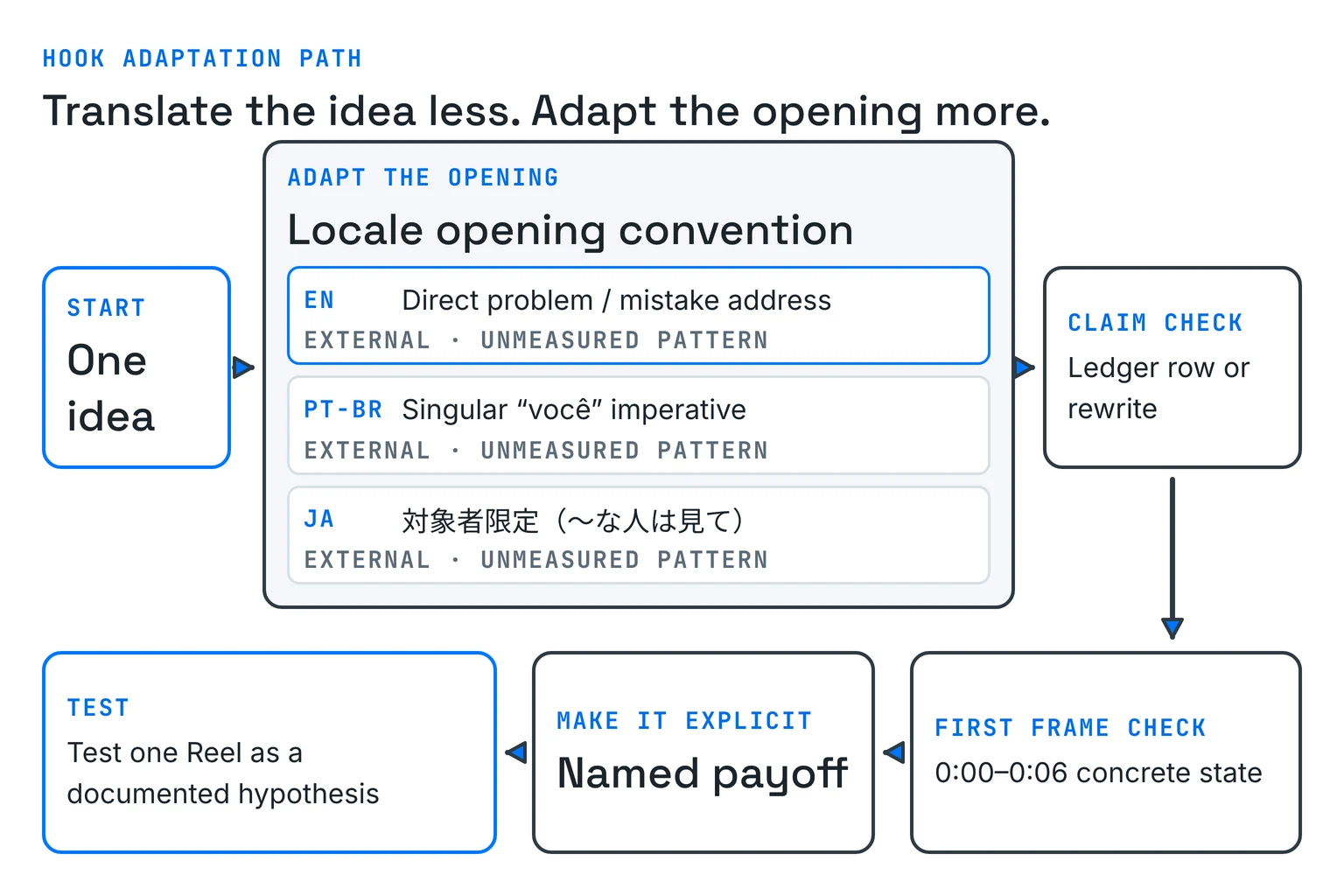
Now you can review the locale choice, evidence boundary, visual premise, and payoff before the Reel is reused. The ordered checks ask you to examine unsupported result claims and first-frame conflicts during review.
Read the evidence as a practitioner corpus, not a benchmark
The Fortalece knowledge report owned by Marketing and Brand, updated 2026-08-24, synthesizes external research conducted on 2026-08-24: seventeen blog sources and eleven usable YouTube transcripts across English, Brazilian Portuguese, and Japanese. None of the patterns was measured on AI Maker Lab accounts.
The corpus is useful as a structured set of practitioner conventions, not as a study or sampling frame. Its creator-reported materials do not disclose reproducible sampling frames, raw datasets, selection rules, or account-level outcome tables, and the automatic captions in all three languages contain punctuation omissions and recognition noise.
The earlier research digest, How Instagram Reel scripts change across English, Portuguese, and Japanese, maps what practitioner tutorials teach about Reel script structure; this article instead supplies the hook adaptation-and-check procedure.
For the causal structure after that opening promise, Storytelling Basics for Marketing Reels shows how a real constraint forces a choice and leads to visible proof.
Mechanics that recur across the source corpora
A one-to-three-second opening window recurs as practitioner guidance in Hootsuite (2024-01-29), Metricool (2024-11-19), Postgrain (2024-10-03), Verônica Oliveira (updated 2024-06-16), Dai Morandi (2024-11-20), Ana Carolina Fernandes (2024-03-29), Mari Perzi (2025-01-09), TaTap (2026-07-12), 株式会社FIRST (2026-05-24), and インスタラボ / Find Model (2025-08-26). It is not an AI Maker Lab threshold.
The recurring first-frame practices are bounded and practical:
- make the premise legible without audio;
- show the concrete subject, failed state, comparison, or action instead of a generic setup;
- use result-before-process only when the result is real; and
- keep frame one low-friction with one focal action, readable text, strong contrast, and a clearly labeled comparison.
The recurring verbal families are a recognized problem or mistake, curiosity with an honest payoff, audience self-selection, contrarian correction, and a visible comparison, challenge, or list. These are descriptive groupings, not ranked options.
The recurring retention structure is equally concrete: make one promise and pay off that promise; make progress visible; cut dead air and post-payoff padding; use visual changes that explain the current beat; and use an account’s retention curve as an edit map that supplies questions rather than as a universal target.
Adapt the English hook, frame, and payoff
For the English opening, I’d start with the promise you can actually pay off.
Every English formula below is an external, unmeasured hypothesis. The reviewed sample is English-language and largely US creator-marketing material, not a study of all English-speaking audiences.
Compare each English formula’s template, example, use condition, and source keys.
| Formula | Template | Example | Use when | Kata sources |
|---|---|---|---|---|
| Curiosity Goldilocks | “This one [change] changed [area], and I didn’t expect [consequence].” | “This one prompt changed how I plan AI demos, and the useful part isn’t the output.” | The body can reveal a real, non-obvious mechanism. | [EN B1][EN V1] [EN V2] |
| Costly Mistake Callout | “If you’re still [behavior], you’re [specific risk]. Here’s why.” | “If you’re pasting customer data into every AI tool, you’re creating a privacy risk. Here’s why.” | The consequence and correction are defensible. | [EN B3][EN V1] [EN V2] |
| Direct Identity Address | “If you’re a [audience] struggling with [problem], [listen up/keep watching].” | “If you’re a solo founder struggling to explain your AI feature, keep watching.” | Fast self-selection matters more than breadth. | [EN B1][EN V2] |
| Personal Turning-Point Story | “I almost [quit/lost/abandoned X] when [moment]. Here’s what happened.” | “I almost scrapped this automation when the first live demo failed. Here’s what happened.” | A truthful postmortem, founder lesson, or origin moment supplies the body. | [EN B1][EN V1] [EN V2][EN V3] |
| Comparison Showdown | “[Option A] vs. [Option B]: which one actually [outcome]?” | “AI voice notes vs. typed prompts: which gives clearer project briefs?” | Both options can be shown against the same visible criteria. | [EN V1][EN V2] |
| Contrarian Correction | “Stop [common behavior]. [Specific alternative] instead.” | “Stop asking AI for ‘better copy.’ Give it one decision to improve instead.” | The alternative can be explained and qualified. | [EN B1][EN V2] [EN V3] |
In this sample, English execution uses a conversational US-creator register with contractions, direct second-person address, “here’s why,” and first-person turning points. Individual-result narratives are unusually prominent in the sample, but every result still needs attributable evidence.
For the checked adaptation, put a short conversational headline beside the actual person, interface, failed build, or comparison. If the hook opens a comparison, apply the same visible criteria on both sides and delay the verdict until after the evidence. If it opens a personal story, close with what changed, what did not, and the useful limit rather than generalizing the anecdote.
Adapt the Brazilian Portuguese hook, frame, and payoff
For Brazilian Portuguese, don’t sand the spoken voice into formal documentation.
Every Brazilian Portuguese formula below is an external, unmeasured hypothesis. The reviewed sample describes Brazilian creator material, not generic Portuguese or a population-wide communication style.
Compare each Brazilian Portuguese formula’s native template, English gloss, example, use condition, and source keys.
| Formula | Native template and English gloss | Native example and English gloss | Use when | Kata sources |
|---|---|---|---|---|
| Contraste de autoridade | “Se eu fosse [perfil], eu jamais [ação] — e vou te explicar por quê.” English gloss: “If I were [profile], I would never [action], and I’ll explain why.” | “Se eu estivesse começando em IA hoje, eu jamais pediria para a ferramenta ‘fazer tudo’.” English gloss: “If I were starting with AI today, I would never ask the tool to ‘do everything.’” | The Reel questions a common practice and demonstrates a concrete alternative. | [PT-BR V1][PT-BR V3] [PT-BR B5] |
| Verdade escondida | “O que ninguém te conta sobre [tema] é [pista].” English gloss: “What nobody tells you about [topic] is [clue].” | “O que ninguém te conta sobre prompts é que o contexto vale mais do que uma frase ‘mágica’.” English gloss: “What nobody tells you about prompts is that context matters more than a ‘magic’ phrase.” | The clue is a genuinely omitted or counterintuitive nuance. | [PT-BR V1][PT-BR B5] |
| Imperativo de interrupção | “Pare de [ação] agora; faça [alternativa] primeiro.” English gloss: “Stop [action] now; do [alternative] first.” | “Pare de trocar de ferramenta toda semana; termine um fluxo simples primeiro.” English gloss: “Stop switching tools every week; finish one simple workflow first.” | The alert has an immediate, demonstrable correction. | [PT-BR V1][PT-BR V2] [PT-BR B5] |
| Promessa direta para você | “Hoje você vai aprender a [resultado] em [N] passos, sem [obstáculo].” English gloss: “Today you’ll learn to [result] in [N] steps, without [obstacle].” | “Hoje você vai aprender a resumir uma reunião em três passos, sem copiar cada fala à mão.” English gloss: “Today you’ll learn to summarize a meeting in three steps, without copying every line by hand.” | The steps are real and the named obstacle matches the delivery. | [PT-BR V1][PT-BR V2] [PT-BR B1] |
| Diagnóstico do erro invisível | “Você está [esforço] e ainda [resultado ruim]? Este pode ser o erro.” English gloss: “Are you [making an effort] and still [getting a bad result]? This may be the mistake.” | “Você está criando conteúdo toda semana e ainda trava na hora de publicar? Este pode ser o erro.” English gloss: “Are you creating content every week and still freezing when it is time to publish? This may be the mistake.” | The Reel can confirm or correct a specific diagnosis. | [PT-BR V1][PT-BR B5] |
| Discordância com assunto quente | “[Pessoa/ideia], eu vou discordar: [tese curta].” English gloss: “[Person/idea], I disagree: [short thesis].” | “Essa trend diz que você precisa de dez ferramentas; eu discordo: precisa de um fluxo que funcione.” English gloss: “This trend says you need ten tools; I disagree: you need one workflow that works.” | A current public idea can be answered with an argument rather than an attack. | [PT-BR V3][PT-BR V4] |
The sample’s distinctive execution uses singular você, colloquial imperatives, and oral forms such as “pra,” “tá,” and “bora.” Humor and reaction should fit the presenter instead of imitating a stereotype.
For the checked adaptation, pair the short você-directed line with the relevant presenter, object, or screen already visible. Keep the written overlay as conversational as the spoken delivery. Carry the same promise through a Gancho → Proposta de valor → Solução/CTA close, preserving natural oral cadence and a direct handoff into the single ask.
Adapt the Japanese hook, frame, and payoff
For Japanese, I’d choose the spoken persona and the caption plan together.
Every Japanese formula below is an external, unmeasured hypothesis. The reviewed creator and agency sample does not establish fixed traits of Japanese audiences.
Compare each Japanese formula’s native template, English gloss, example, use condition, and source keys.
| Formula | Native template and English gloss | Native example and English gloss | Use when | Kata sources |
|---|---|---|---|---|
| 損失回避(知らないと損) | 「知らないと損する、[対象テーマ]の[数字]つのコツ」 English gloss: “You’ll miss out if you don’t know these [number] tips about [topic].” | 「知らないと損する、ChatGPTで資料を作る3つのコツ」 English gloss: “You’ll miss out if you don’t know these three tips for making documents with ChatGPT.” | The cost is real and explainable; the hook does not manufacture fear. | [JA B2][JA V1] [JA V3] |
| 対象者限定(〜な人は見て) | 「[具体的な悩み]の人は見て」 English gloss: “If you have [specific problem], watch this.” | 「AIを仕事で使いたいけど、何から始めるか迷ってる人は見て」 English gloss: “Watch this if you want to use AI at work but do not know where to start.” | The intended viewer can recognize the situation or desire immediately. | [JA V1][JA B4] |
| 目的直結(〜したいなら) | 「[望む結果]したいなら、まず[意外な第一歩]」 English gloss: “If you want [result], start with [unexpected first step].” | 「AIで作業時間を減らしたいなら、まずプロンプトを書かないで」 English gloss: “If you want AI to reduce work time, first do not write the prompt.” | The tutorial can justify the unexpected first step immediately. | [JA V1][JA B6] |
| 禁止・中止命令(今すぐやめて) | 「[よくある行動]、今すぐやめて」 English gloss: “Stop [common action] right now.” | 「ChatGPTにいきなり質問するの、今すぐやめて」 English gloss: “Stop asking ChatGPT questions without preparation right now.” | The downside is demonstrable and the negative phrasing is not merely decorative urgency. | [JA V1][JA V3] |
| 常識反転(実は逆効果) | 「[一般的な常識]すると、実は[逆の結果]になることがあります」 English gloss: “If you [common practice], it can cause [opposite result].” | 「AIに詳しく指示しすぎると、実は答えがぼやけることがあります」 English gloss: “If you over-specify instructions to AI, the answer can become less clear.” | A qualified correction has visible evidence or clearly named conditions. | [JA V3] |
| 問いかけ二択(知ってる?/どっち?) | 「[ツール・方法]、知ってる?」/「[A]と[B]、どっちを使ってる?」 English gloss: “Do you know [tool/method]?” / “Which do you use, [A] or [B]?” | 「文章の要約、ChatGPTとNotebookLMどっちを使ってる?」 English gloss: “For summarizing text, which do you use: ChatGPT or NotebookLM?” | The opening is a quick knowledge check or bounded comparison. | [JA V1][JA V3] |
In this sample, テロップ is an expected information channel, and the choice between 敬語 and タメ口 is a deliberate persona decision. No reviewed source compares the performance of those registers.
TaTap’s 冒頭2秒 convention is dated 2026-07-12 and is house guidance, not an AI Maker Lab cutoff. For the checked adaptation, make the subject intelligible in the opening frame, match the written テロップ to the chosen spoken register, and reserve a stable region for synchronized captions. Carry the hook through タイトル → 理由 → 根拠 → 行動促進, then resolve the opening title without letting a separate まとめ card compete with the final ask.
Reject unsupported loss, duration, and outcome claims
When a formula sounds wonderfully specific, I stop and ask what was actually measured.
A familiar formula does not make its implied measurement safe. Loss-aversion and outcome-number openings such as 「知らないと損する」 or “[result] in [timeframe]” can imply a measurable cost, duration, or result. The AI Maker Lab hook-safety note dated 2026-07-28 rejected the line “making one takes hours I don’t have” because no per-video duration had been measured.
Use this claim filter before scripting:
| Formula element | Evidence question | Disposition |
|---|---|---|
| Loss or cost | Is the specific cost real, attributable, and cited? | Keep the measured claim only with the citation; otherwise name the felt problem qualitatively. |
| Duration or timeframe | Was the duration measured under stated conditions? | Keep the duration only with its source and conditions; otherwise remove it. |
| Outcome number | Does the Reel show or cite the same measured outcome? | Keep only the attributable value; otherwise promise a demonstration, comparison, or diagnosis instead. |
| Personal result | Can the speaker show the actual artifact, setup, and limit? | Keep it as a bounded first-person observation, not a general result claim. |
The table keeps the four formula elements separate; the figure below shows only the keep-or-rewrite decision they share.
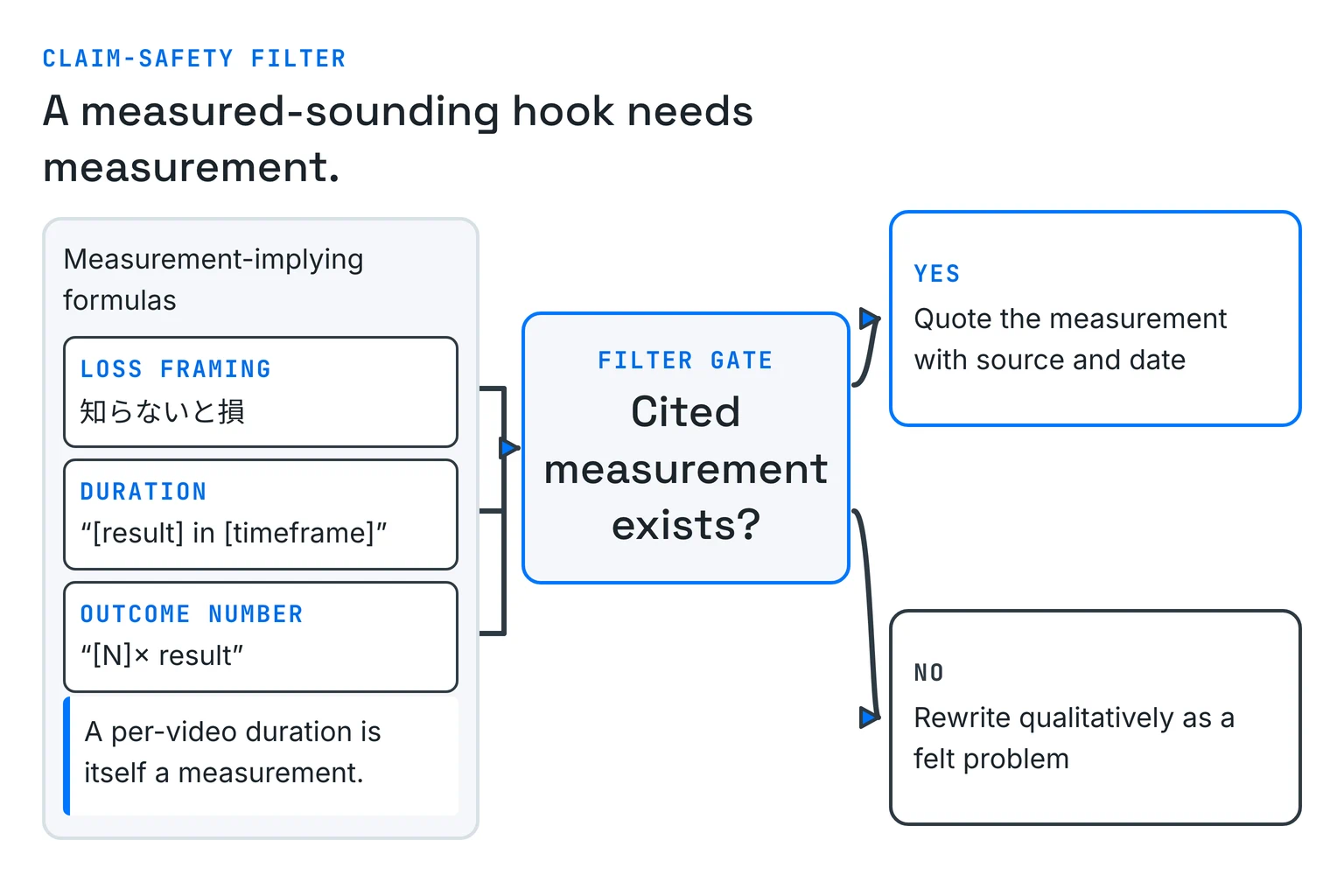
The safe rewrite preserves the situation and removes the invented magnitude. It does not replace one unsupported number with another.
Check the first frame and payoff
Now put the words beside the pixels: you need an opening the evidence and the frame can both carry.
The AI Maker Lab E5 visual gate, recorded in the editorial gap report on 2026-07-29, requires: “Within 0:00–0:06 the pixels must show a concrete state of the problem, consequence, or result. No mostly-empty, placeholder, or generic layout held longer than 1.0 s.” This AML gate remains binding; the practitioner opening-window suggestions remain external hypotheses.
AI Maker Lab Reels retain the Instagram playbook’s first-person felt-problem spoken opening. Outcome-first or result-first research patterns may describe a verified payoff after the problem or a concurrent visual; they never license spoken copy to open on an unsupported result. E5 still allows a concrete problem, consequence, or result, and external sources sometimes put a real result first. The current rules do not resolve when a verified result-first visual should displace a problem-first spoken opening.
Keep the existing sequence: “first-frame hook → demonstration or evidence → concise explanation → one CTA.” The owner-directed AI Maker Lab playbook section dated 2026-07-28 also adds “What → So what → Now what”; the external corpus does not justify changing either order.
For payoff review, ask whether the body resolves the exact hook, whether progress is visible, whether every visual change explains the current beat, and whether any post-payoff padding can be removed. If account-specific retention data later exists, use drop points to inspect opening, middle, or close edits without importing an external target. Use the Instagram and Facebook Reels retention benchmark guide to freeze scope and interpret those account-specific drop points before choosing the next opening test.
Keep one promise across the cover and opening
Treat the selected cover, frame zero, and the first three seconds as three separate surfaces joined by one promise.
| Surface | Where it appears | Its job |
|---|---|---|
| Selected cover | Profile grid and any non-autoplay preview that displays the chosen cover | Identify the topic and offer an honest reason to open. |
| Frame zero | The actual video at 0.000 seconds | Make the subject and stake concrete before audio is needed. |
| First 0–3 seconds | The opening playback window | Visibly progress the same problem, result, comparison, or demonstration. |
Instagram publishing workflows can expose a selected or custom cover and a profile-grid crop adjustment. That interface is version-sensitive, so inspect the current in-app preview rather than hard-coding a crop shape or percentage from practitioner guidance.
Cover selection and opening retention are distinct hypotheses. This 2026-08-26 research pass found no public Instagram causal cover study and no causal AI Maker Lab packaging result. Adjacent YouTube thumbnail and instructional-video eye-tracking research supports treating preview imagery as a selection surface, but it does not prove that an Instagram cover causes retention.
Meta’s Reels-ad guidance recommends vertical creative and keeping key messages inside the Reels UI safe zone. Carry that paid-placement hygiene into the review, not its outcome figures or a numeric organic safe-zone guarantee.
Locale adaptation should preserve the same subject across all three surfaces even when the words change. The cover may compress the locale-native opening, but frame zero still has to make that promise concrete, and the next three seconds should continue it with evidence-compatible pixels.
This continuity model sits inside the existing AI Maker Lab E5 gate because frame zero and the first three seconds both fall within its 0:00–0:06 opening window. It does not change the Instagram playbook, add a performance claim, or turn a proposed packaging practice into an AML result.
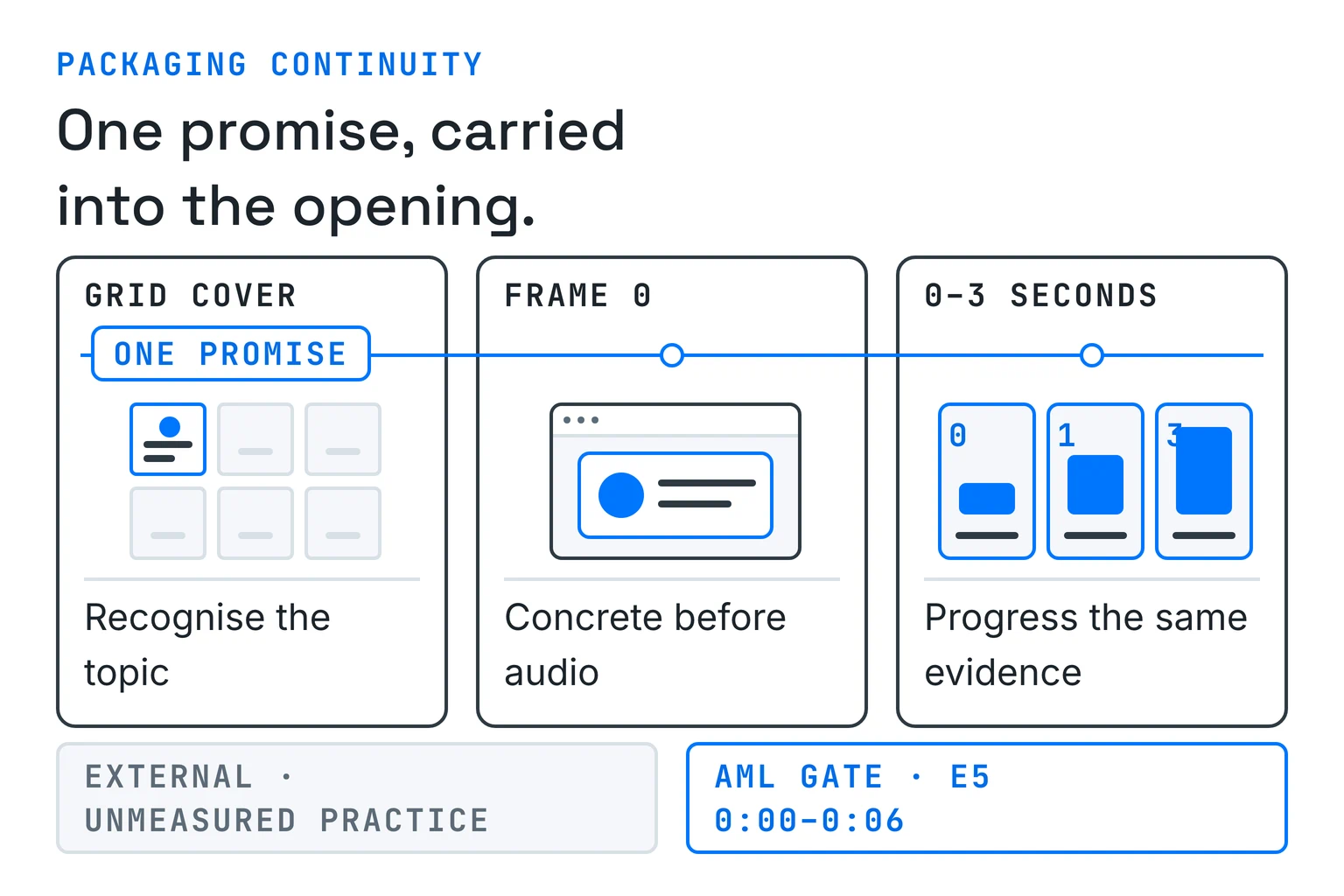
Trial Reels can provide a non-follower-first comparison workflow when the feature is available. Hold the recorded variables as stable as practical, freeze each cover and opening identity, and treat sequential comparisons as quasi-experimental unless Instagram randomizes assignment for the tested surface.
Protect caption geometry and single-CTA timing
Then I check whether the frame can carry the presenter, evidence, captions, and close without a traffic jam.
Caption geometry creates a separate conflict. The owner-directed Instagram playbook section dated 2026-07-28 places the presenter at bottom-left at 26–30% of frame height with 24 px margins and permits no caption or evidence occlusion. Japanese フルテロップ expects a dense, persistent text channel, while E4, recorded in the editorial gap report on 2026-07-29, requires every viewer-required line to be legible at 960×540 without pausing. The current playbook allocates no Japanese caption safe region.
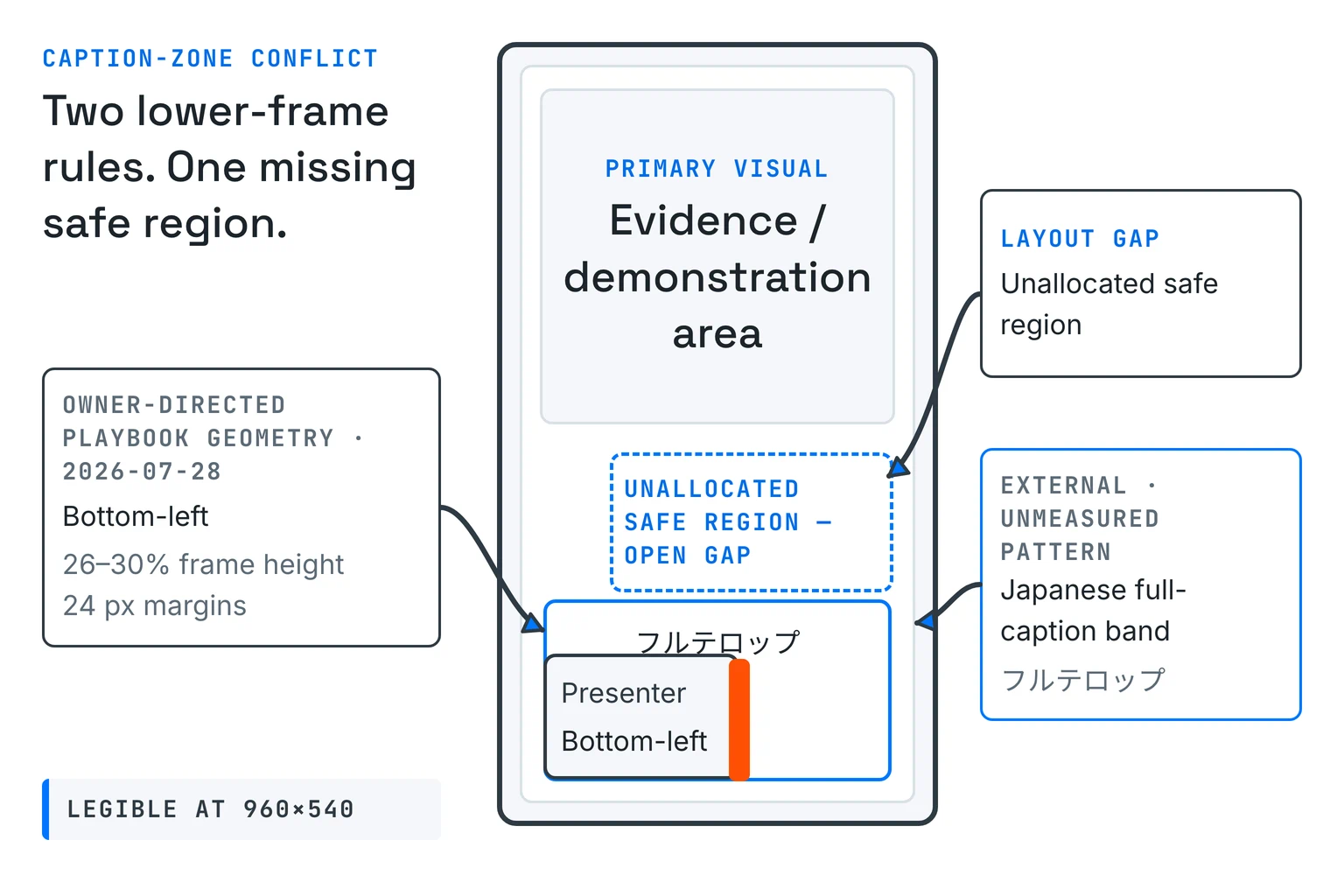
Figures 1, 2, and 4 are authored deterministic diagrams rendered from HTML and CSS, with production records under assets/illustrate/2026-08-25-instagram-reel-hooks-by-language-figures/; figure 3 uses assets/illustrate/2026-08-26-instagram-reel-packaging-figure/. They add no performance claim.
The same owner-directed section dated 2026-07-28 requires a single CTA, spoken and on-screen in the final three seconds. A Japanese まとめ card or Brazilian GPS close can carry that ask, but the sources do not resolve how to prevent the recap and CTA from competing for reading time.
Keep the unresolved tensions visible
I won’t pretend these conflicts are settled; the current evidence leaves them open:
- E5 permits problem, consequence, or result pixels, but the current problem-first rule does not define an exception path for result-first openings.
- Japanese フルテロップ and the bottom-left presenter rule still need an allocated, E4-legible caption region.
- A Japanese まとめ close or Brazilian GPS close may compete with the final CTA for reading time.
- English, Brazilian, and Japanese sources converge on removing dead air, and Brazilian and Japanese sources explicitly remove greetings or the opening pause, but the current Reel recipe does not adopt a no-greeting or first-pause rule.
The Fortalece kata owned by Marketing and Brand, updated 2026-08-24, records six proposed Instagram-playbook additions: first-frame selection, no-greeting and no-empty-opening-pause review, locale caption-zone review, hook-claim review, promise-to-payoff review, and account-specific retention review without external benchmarks. They remain recommendations; AI Maker Lab’s internal Instagram channel playbook was not modified, and owner approval is still required.
The same kata marks a story-memory multiplier from Build Your Tribe (2026-03-02), a preference figure attributed to EmbedSocial in Verônica Oliveira (article updated 2024-06-16), a distribution threshold from Rafael Kiso (2024-03-18), and a title-length limit from さき-インスタの大学 (2025-10-19) as named-source uncited claims. This guide does not adopt them or restate their numbers.
Adapt one hook as a documented hypothesis
Before reuse, keep the hook documented as an external, unmeasured hypothesis.
Do not attach a promise of reach, retention, saves, shares, subscribers, or conversion to the procedure. The locale formula remains external and unmeasured until account evidence says otherwise.
Next step: Adapt one locale-native hook as a documented hypothesis, then use How Instagram Reel scripts change across English, Portuguese, and Japanese to shape its script and test it in one Reel before reuse.
Sources
We build Fortalece.ai, which holds AI Maker Lab’s own Reel hook kata and packaging-extension research records; they are first-party, not third-party or independent research. The Reel hook kata is Fortalece knowledge document 72fcf8f0-92dc-481a-8ae8-edfc89029537 (the internal record ID), revision 2, at the internal wiki path marketing/research/instagram-reel-hook-kata, owned by Marketing and Brand and updated 2026-08-24; its byte-identical repository mirror is the internal source file docs/content/instagram-reel-hook-kata.md. The packaging extension is live record 23943baf-63d8-4c06-afc1-bf7f1517c789, Instagram Reel Packaging — Cover, Grid, and First 3 Seconds, revision 1, read on 2026-08-26 at marketing/research/instagram-reel-packaging; its body is marked draft research and owner review required, and its API owner field is null. It found no public Instagram causal cover study and no causal AML packaging result. The records register the external sources below; source-title wording is metadata, not endorsement.
Packaging and preview sources
The key distinction is what each source can support—and what it cannot.
| Publisher | Source | Date and limit |
|---|---|---|
| Meta for Business | Reels ads creative guidance | Date not recorded; paid-placement hygiene only |
| Meta Newsroom | Trial Reels: test content with non-followers first | 2024-12; platform workflow, not causal evidence |
| Meta Newsroom | Trial Reels availability and grid flexibility | 2025-06; verify current product availability |
| Later | Instagram Reel cover workflow and crop preview | 2025-08-22; practitioner and version-sensitive |
| Koh and Cui | Thumbnail attributes and branded YouTube video views | 2022; adjacent observational YouTube evidence |
| Veith et al. | Eye tracking of instructional-video selection | 2024; adjacent selection evidence, not Instagram |
| TechCrunch | Instagram View Rate reporting | 2025-01-29; secondary report, verify the current in-product definition |
English sources
Blogs
Compare the English blog sources by publisher, title, and publication date.
| Key | Publisher | Title | Date |
|---|---|---|---|
| EN B1 | Buffer | The Anatomy of a Great Hook: How to Grab (and Keep) Attention in 2026 | 2025-08-12 |
| EN B2 | Buffer | How the Instagram Algorithm Works: Your 2026 Guide | 2026-03-24 |
| EN B3 | Hootsuite | The Science Behind Good Social Media Hooks + 18 Examples | 2024-01-29 |
| EN B4 | Later | Instagram Reels algorithm: How it works in 2026 | 2026-06-25 |
| EN B5 | Metricool | Instagram Reel Analytics: Retention & Skip Rate Explained | 2026-02-04 |
| EN B6 | Metricool | 25 Viral Video Hooks for Short-Form Videos | 2024-11-19 |
Videos
| Key | Publisher/channel | Title | Date and identifier |
|---|---|---|---|
| EN V1 | Vista Social | I Analysed 1000+ hooks, here’s what works on instagram in 2026 | 2026-06-01; CUwV4gmcTiE |
| EN V2 | Build Your Tribe | I Studied 1,300 Hooks, Here’s What Actually Works | 2026-03-02; QTgabAQ9kCU |
| EN V3 | pushREC | Robert Zinke | 7 VIRAL Content HOOKS That Stop The Scroll [+ AI Prompt] | 2023-10-04; VfPzAKaRsAU |
Brazilian Portuguese sources
Blogs
| Key | Publisher | Title | Date |
|---|---|---|---|
| PT-BR B1 | mLabs | Vídeos no Instagram: como criar posts com zero defeitos | Published 2025-03-10; modified 2026-02-24 |
| PT-BR B2 | Postgrain | Nova Métrica do Reels: Saiba a quantidade de dias que o seu post foi visualizado! [2024] | 2024-10-03 |
| PT-BR B3 | Postgrain | Instagram Reels: Qual o tamanho ideal do seu vídeo? | 2025-03-13 |
| PT-BR B4 | Verônica Oliveira | [2024] Reels no Instagram: 10 dicas para dominar esse conteúdo | Published 2023-06-14; updated 2024-06-16 |
| PT-BR B5 | Nikau | 10 Ganchos Infalíveis para Aumentar o Engajamento nos Reels | 2026-04-28 |
Nikau is a commercial, lower-confidence example bank with no comparative evidence; the kata does not adopt the source title’s “infalíveis” wording.
Videos
| Key | Publisher/channel | Title | Date and identifier |
|---|---|---|---|
| PT-BR V1 | Dai Morandi | 30 GANCHOS MAGNÉTICOS pra você DOMINAR os REELS | 2024-11-20; oFlYhRSqNNE |
| PT-BR V2 | Ana Carolina Fernandes | COMO USAR GANCHOS SUBLIMINARES PARA VIRALIZAR MAIS RÁPIDO NO INSTAGRAM? Aprenda estratégias de COPY! | 2024-03-29; lj223t0xSfw |
| PT-BR V3 | Mari Perzi | COMO VIRALIZAR NOS REELS em 2025 (NOVO MÉTODO) | 2025-01-09; OthsuUfJN8U |
| PT-BR V4 | Rafael Kiso | 10 fatores para VIRALIZAR no INSTAGRAM REELS | 2024-03-18; wzBHYuzRYjs |
Japanese sources
Blogs
Compare the Japanese blog sources by publisher, title, and publication date.
| Key | Publisher | Title | Date |
|---|---|---|---|
| JA B1 | インスタラボ / Find Model | 【最新ニュース】Instagram、リールに「視聴維持率」などの新指標を追加 | 2025-08-26 |
| JA B2 | 株式会社FIRST | インスタリール動画がバズる仕組みを解説!再生回数を伸ばすポイントも紹介 | 2026-05-24 |
| JA B3 | freedoor株式会社 | 【完全攻略】Instagramリール動画の再生回数を最大化する方法 | 2025-02-03 |
| JA B4 | TaTap | Instagramリール徹底攻略|アルゴリズムと勝ちパターンの全貌【2026年最新】 | 2026-07-12 |
| JA B5 | COCOマーケ | 伸びるリールの最適な長さは何秒?完全視聴率で決める2026年の尺の使い分けガイド | Published 2026-07-16; updated 2026-07-21 |
| JA B6 | Buzz Brain株式会社 | リール台本の作り方は?店舗向けテンプレートと構成のコツを解説 | Published 2026-02-15; updated 2026-04-09 |
Videos
| Key | Publisher/channel | Title | Date and identifier |
|---|---|---|---|
| JA V1 | さき-インスタの大学 | 【今すぐできる!】リールの最初に入れるだけでバズりやすくなるワードを紹介します! | Uploaded 2025-10-04; 1FeEn1L6xwM |
| JA V2 | カイシャインのSNS高校@インスタ攻略 | 【たった10投稿で3万人】冒頭3秒で激変!不発から160万再生に化けた“インスタリールの作り方”を完全解説!インスタ外から発想を輸入する方法! | Uploaded 2025-09-26; Bb9KD1ohMQs |
| JA V3 | さき-インスタの大学 | 【2025年完全版】インスタリールでバズを連発する方法を0から全て教えます! | Uploaded 2025-10-19; Wiz9IZCXigs |
| JA V4 | さき-インスタの大学 | 【リール実践】フォロワー50万人インスタ運用者がリールの作り方とコツを実演して教えます! | Uploaded 2025-01-21; cNnhtmo9K9A |