
Every number gets a source
In October, we asked where the numbers in our browser driving sim, Seat Time, came from. We build it with artificial intelligence (AI) coding agents. Across 26 cars and 286 cells, 109 answers were still our own reasoning.
We wanted a reason behind every value, from the engine curve to the springs. Some came from specifications; others were plausible guesses. Giving them labels made that difference visible, and the corrections reached beyond the spreadsheet.
Previously: Every merge is a release.
We gave every number a label
The agents built a grid with 11 columns for each car. Those covered mass, engine curve, gearing, springs, dampers, anti-roll bars, differentials, mass distribution, frame stiffness, tyres and aerodynamics. A cell described a whole quantity or system, rather than every individual constant inside it.
The 19 October 2026 snapshot contained 60 cited cells, 117 sourced estimates and 109 reasoned estimates. None remained without a basis. That last result meant we could explain our choices; it didn't mean we had measured the cars.
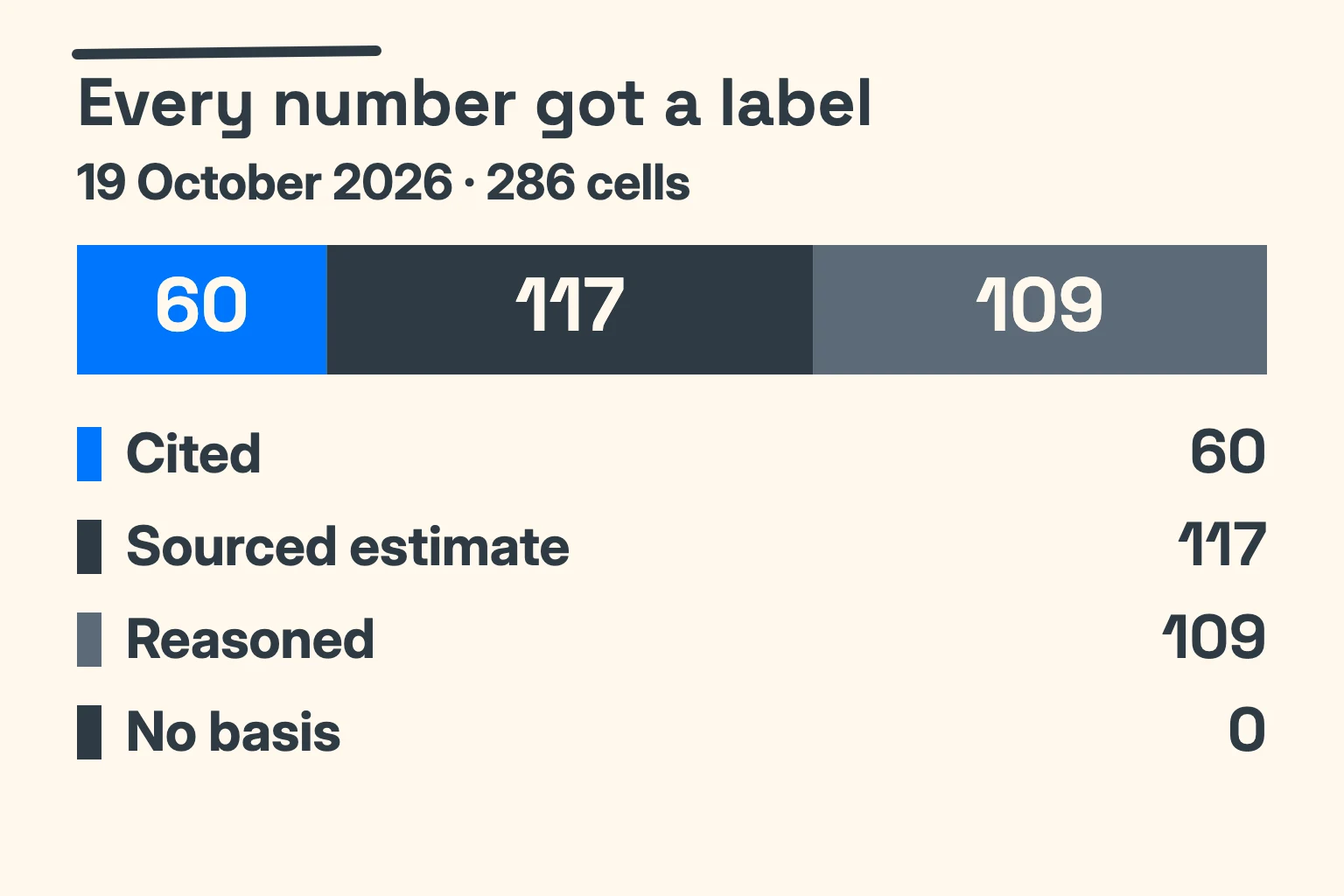
A cited value came straight from a source, or from arithmetic using it. A sourced estimate used published data but needed an engineering step. A reasoned estimate relied on a written argument, such as a comparable car or a class rule.
The checker required that trail in each car's research record. It rejected the old combination of “estimate” and no stated basis. We could keep an estimate, but we had to say how we arrived there.
The grid also separated sourcing from agreement. A cell could identify a published basis while the game still used the wrong value. That distinction gave the agents a correction list instead of a reassuring wall of citations.
147 corrections in one pass
On 19 October, we applied 147 correction rows in physics 6. Our kei truck—a Japanese light truck—went to 815 kg, including the driver. The mass calculation used 740 kg from the Suzuki Carry specifications, plus our chosen 75 kg driver.
The same Suzuki table supplied the gearing for the two-wheel-drive manual variant. Its first-gear ratio is 5.809, with a final-drive ratio of 4.555. We also removed the in-game truck's front anti-roll bar during this correction pass.
Elsewhere, we gave the Formula Junior an open differential and a 6300 rpm (revolutions per minute) limit. Ronin received its sequential twin-turbo setup. These changes were to the simulated cars. They didn't mean the cars' complete behaviour now matched real vehicles.
The corrections moved licence and curriculum targets by about 0.1–0.2 s in either direction. Pocket and Ladybird still missed their sourced 0–100 km/h time bands. We kept those misses visible instead of treating the source labels as a pass.
That was the useful friction in the exercise. We could point to why a parameter changed without claiming the whole car was finished. A better input and a matching outcome remained separate jobs.
Six bodies needed new dimensions
The research pass also reached the visible cars. We re-exported Tempest, Sable S2, Ronin, Pocket, Ladybird and GT3 from Blender at their reference body dimensions. Six corrected bodies accompanied the numerical changes.
That gave the work a shape beyond tables of springs and ratios. The body dimensions were another set of inputs we could compare with a stated reference.
The upside-down kei sank through the road
The kei follow-up carried a less subtle problem: an upside-down car sank through the road. We finished that work in physics 7. An earlier attempt had never reached the main build, so we had to land the work again.
This connected directly to the release problem from the previous episode. Having an agent finish a change wasn't enough; the change had to reach the build. A researched specification could not rescue a fix that never arrived.
We built mass from its parts
The next step came after the 19–25 October week, in physics 10. We built mass layouts from positioned engines, gearboxes, drivers, seats, batteries and fuel. The committed results table covers 27 cars, including Kite-2400.
A remaining frame element carried whatever mass those parts didn't account for. We positioned it to preserve the car's existing total mass, front-weight share and centre-of-gravity height. The layout changed how that mass was distributed without quietly replacing those totals.
Every part position was still our estimate. Off-centre components moved the centre of gravity sideways, with nonzero offsets of 16–48 mm in magnitude. The single-seaters remained centred, so that range doesn't describe every car.
The kart showed why placement mattered. Its estimated yaw inertia—resistance to changing its rotation in a turn—became 44 kg·m². That was down 38% from the old box model. Much of its mass sat near the centre, chiefly the driver. It wasn't spread throughout a solid body-sized box.
That figure is an estimate from our layout, not a measurement of a real kart. The distinction matters because the calculation can be precise while the part locations remain approximate. More detailed arithmetic doesn't supply missing measurements.
The release also arrived with a drift demonstration still failing. The follow-up recalibrated it rather than hiding that unfinished result. Building the mass model changed the task facing the demonstration driver as well as the numbers in our table.
Stiffer frames, almost the same handling
Frame stiffness was the next follow-through, eventually applied in physics 15. We compiled a dataset containing 114 published torsional-stiffness figures. Torsional stiffness describes resistance to twisting along the car's length.
Published did not mean equally dependable. Our dataset mixed measurement methods, and many entries came through secondary compilations. The count describes the material we collected, not 114 independently verified measurements.
We used cited figures, relationships between related cars and a fitted trend to choose the road-car values. We also imposed a floor: frame stiffness at least three times wheel roll stiffness. Here, wheel roll stiffness means the springs' and anti-roll bars' combined resistance to body roll at the wheels.
Our research cited Deakin and colleagues' study of chassis stiffness and handling balance. Its public abstract examines stiffness ratios and their effect on handling adjustment. The three-times floor is our engineering choice; the abstract doesn't establish that exact threshold.
Kite-2400 went from 18 to 39 kN·m/deg under our rule. Yet the earlier physics-10 trial moved understeer by at most 0.003 deg/g across the tested cars. Understeer here measures how much extra steering the car needs as cornering acceleration rises.
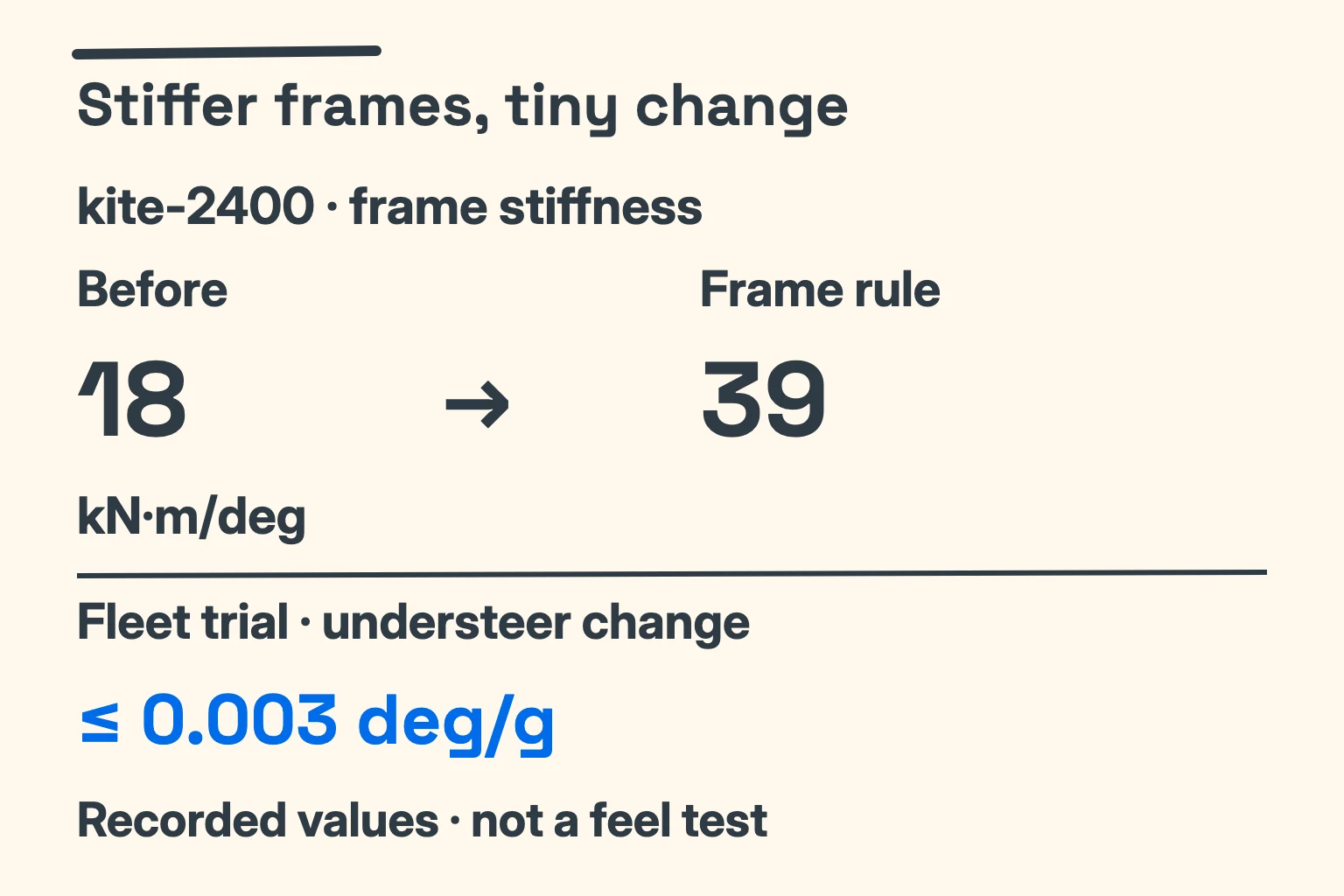
Constant-radius cornering grip moved by at most 0.0007 g. The measured response to a sudden steering input stayed unchanged. Those were small handling changes beside a large change in one input. They were simulation results, not a report from our hands on a wheel.
About 40 regression checks—checks against previous results—still broke during that trial. We deferred the values to a later physics-version change, ultimately physics 15. Tiny output differences can matter to these exact checks even when the handling metrics barely move.
Our interpretation was that these already-stiff frames had little influence on steady handling in this model. We haven't driven these specific changes on hardware yet. The measurements don't tell us whether we would notice a difference through a real steering wheel.
What a source doesn't give us
The labels made the remaining uncertainty easier to name. We still had 109 reasoned cells in the dated October snapshot. Frame-stiffness estimates leaned on weak secondary references, and the mass-layout positions were our own estimates.
A later recount, dated 3 November 2026, recorded 27 cars and 297 cells. It found 68 cited, 120 sourced estimates, 109 reasoned and none without a basis. That's a separate historical snapshot, not a replacement for the October chart or a live count.
The title describes the rule we wanted, not a claim that every value became a published fact. For some numbers, the source was a specification. For others, the honest answer remained a written argument we could revise.
Next, those numbers reach the wheel
The next idea was to feel the result through a real steering wheel inside a browser tab. Open Seat Time and compare two cars in the garage. Next episode: A steering wheel in a browser tab.
Notes and sources
- Sourced fact — first-party build records: the 19 October 2026 snapshot contains 26 cars, 11 categories and 286 cells: 60 cited, 117 sourced estimates, 109 reasoned, zero without basis. These labels describe provenance, not validation. Our agents researched dossiers, built the matrix and applied 147 corrections in physics 6.
- Sourced fact — first-party changes: the kei truck's 815 kg, corrected gearing and removed front bar; Formula Junior's open differential and 6300 rpm limit; Ronin's sequential twin-turbo; six body re-exports; and the kei finalization in physics 7 are recorded build changes. The preceding kei attempt did not reach the main build.
- Sourced fact / chosen design value: Suzuki, Carry equipment and specifications, page 2, December 2025 specification, public PDF. The Carry KX two-wheel-drive manual table gives 740 kg, first gear 5.809 and final drive 4.555. Adding our chosen 75 kg driver gives 815 kg.
- Measured — simulation records: physics-6 targets shifted about 0.1–0.2 s; Pocket and Ladybird retained their 0–100 km/h misses. The 3 November recount gives 27 cars, 297 cells and 68/120/109/0 labels.
- Chosen design values / estimates: physics-10 mass layouts have 27 recorded rows, including Kite-2400. Part positions, nonzero lateral offsets of 16–48 mm, and the kart's 44 kg·m² yaw inertia, down 38%, are model estimates. The residual frame preserves the sourced mass totals. A failing drift demonstration required follow-up recalibration.
- Sourced fact / chosen design value: our stiffness dataset contains 114 published figures of mixed provenance. The three-times floor and resulting Kite-2400 change from 18 to 39 kN·m/deg are our model choices. Deakin, Crolla, Ramirez and Hanley, The Effect of Chassis Stiffness on Race Car Handling Balance, SAE, 2000: public abstract and citation. We read the abstract, not the paywalled paper.
- Measured / our interpretation: the physics-10 stiffness trial changed understeer by at most 0.003 deg/g and skidpad grip by at most 0.0007 g; step response stayed unchanged. About 40 pinned checks broke before the values were deferred and later applied in physics 15. Little steady-handling influence is our interpretation of those model results.
- Not yet driven on hardware: these correction and stiffness results carry no recorded wheel-feel validation. AI assisted this article's drafting and translation. Seat Time's cars are fictional and are not licensed or endorsed by any vehicle manufacturer.