
Five weeks in: what we learned and where it goes next
We build Seat Time, our browser driving sim, at AI Maker Lab with AI coding agents. Our first merge was on 29 September 2026. Five weeks later, we counted 516 merged pull requests—proposals for integrating code. Some accepted work had never reached the shared game code.
On 3 November, our physics version was 17; “17.1” named a release without changing that physics number. More physics work was waiting to be integrated. We wanted to look back at how we got there, including the work a merge count could hide.
How we built it
We directed the agents, made merge decisions, drove builds and listened to them. The agents wrote most of the code and pull-request descriptions. We have no measured authorship split. Their descriptions are our engineering records, not independent reviews of the game.
Seat Time runs in a browser with a force-based physics model. That gave us something to inspect when the car behaved strangely. It also gave us plenty of ways to pass a check that asked the wrong question. The series follows those questions from the first slide to the suspension investigation.
Five weeks, week by week
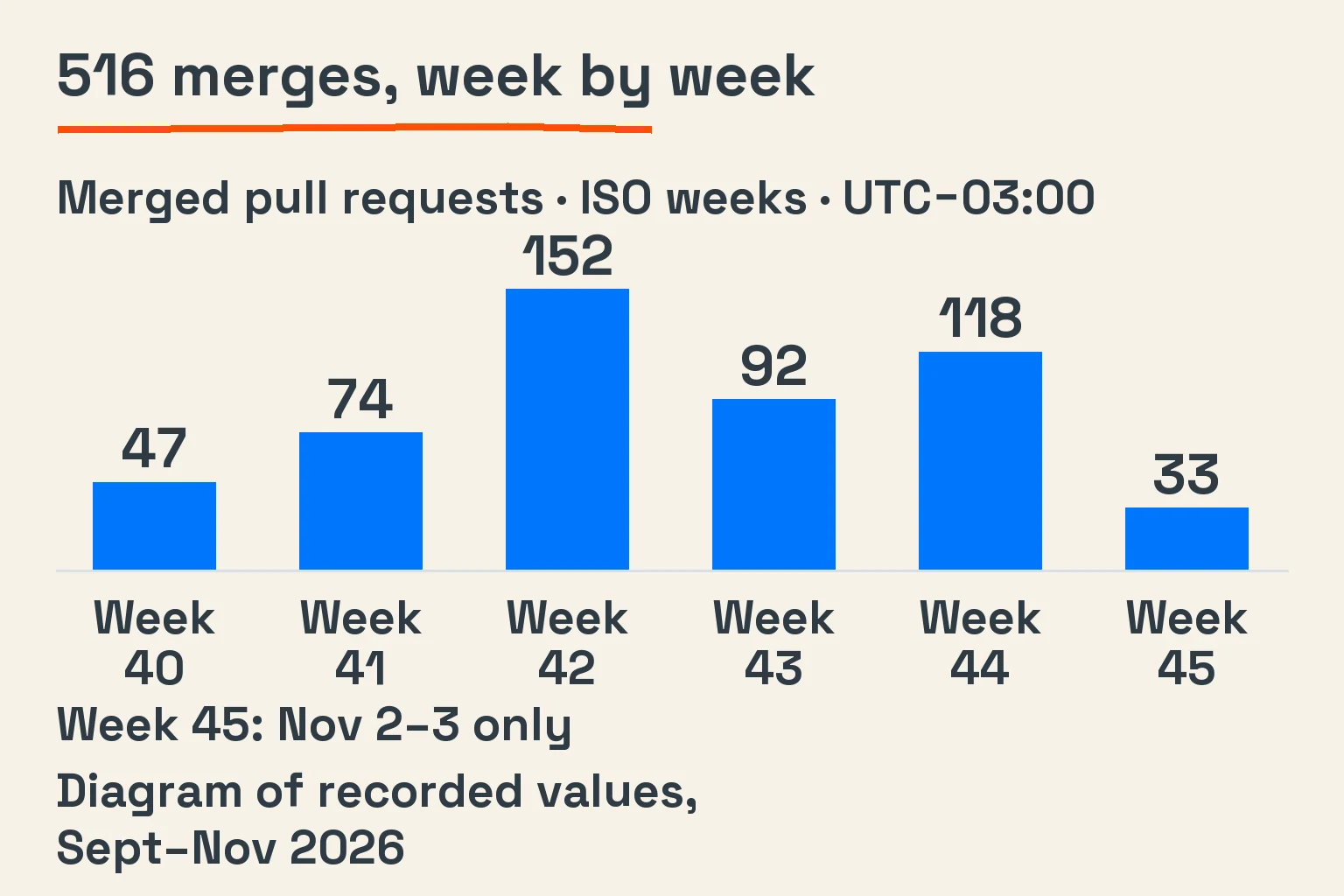
The count rose fastest in week 42, with 152 merges. Across the whole period, 410 went directly into the shared integration line and 106 into intermediate or batch work. Those 106 are not a count of lost features. Some were deliberate staging; delivery had to be checked separately.
| Week in 2026 | Dates | What occupied us |
|---|---|---|
| W40 | 29 Sep–4 Oct | First build, physics gaps, the Magic Formula 6.1 tyre model, recorded engines, cars and rain |
| W41 | 5–11 Oct | Player-car tyre migration, the Graphic Street look, open-data comparisons, parked creep, career and the rename |
| W42 | 12–18 Oct | Kart tracks, kei cars, track tooling, release safeguards, the Seat Life split and drift launch |
| W43 | 19–25 Oct | Sourced car corrections, browser steering-wheel support, loading and server work, official runs |
| W44 | 26 Oct–1 Nov | Physics 8–15, comparisons with Chrono, drift and the learned driver, wheel-feel reversal and course review |
| W45 | 2–3 Nov | Physics 16–17 and release label 17.1, squat, wheel-spin reaction and stale generated values |
The figure shows weekly volume; the table records overlapping work, not six clean project phases. A tyre correction could change a learned driver's results. A physics release could send us back to generated reference values. Finishing one change often exposed the next question.
Physics got a version number
On 12 October, we began stamping laps, ghosts and leaderboard entries with physics version 2. Older, untagged data counted as version 1. Keeping the versions separate meant a lap under changed physics did not silently compete with an older result.
By 3 November, the version had reached 17. The later “17.1” label did not introduce another physics change. Episode 7 tells the release story, including why a version number belongs beside a lap time.
The game outgrew its name
Racing Sim became Seat Time, then split into Seat Time and Seat Life on one engine and save profile. Jobs, licences and a wallet had expanded what surrounded the driving. Episode 6 tells the rename and split, along with the less tidy discovery that accepted work could miss the game.
What broke more than once
A merged proposal needed a destination check. The missing-car story in Episode 6 made that concrete: an accepted car was absent from the selector. Our safeguard checked whether covered merged work actually reached the shared integration history. Exceptions had to remain explicit.
The running game needed a separate check. Episode 7 follows a release that stayed behind, then the checks for live identity and usable controls. That episode also keeps the limits visible: an automatic retry lacked permission, and the monitoring schedule still needed confirmation.
Even our test runner could give an incomplete picture. Some test files were missing from its groups; a coverage guard made that omission visible. Generated values could also describe the wrong code state. We changed the rule to regenerate them against the final integrated code, rather than carry forward reassuring but stale results.
What our hands and ears decided
A passing measurement could still leave the wrong sound or sensation. Our first engine sounded artificial despite its checks. Later, a tyre texture passed frequency checks but felt like added vibration. That recorded drive changed the design.
The other side of that lesson was restraint. The learned drift driver exposed a scoring gap; its pass rate did not establish a good human lesson. Our later physics-release records explicitly noted no pre-merge drive on the G923 wheel or DualSense controller. A merge could not supply that missing verdict.
We have no recorded personal verdict on how the whole five-week process felt. Our interpretation is that delivery discipline mattered more than throughput. The count tells us how much work moved; the missed deliveries and driving reports tell us why we changed the process.
Where it goes next
The record leaves open work, not a promised roadmap. These are the questions left by the episodes, with their dates kept visible.
- Unmerged at the 3 November cutoff: the physics-18 force-path work described in Episode 13. Its 6 November source update records the correction integrated and enabled in play. The code identifies itself as physics 20. No hardware drive is recorded for the squat change—the rear settling under acceleration.
- Open: Link Cedar Basin's shallow-slide scoring gap. The learned driver could satisfy the course with shallower slides than intended. The episode records no scorer fix.
- Not yet driven: the scrub-only wheel reversal and calibrated TRUEFORCE voices. Earlier G923 experiments do not establish how those later changes feel.
- Open comparisons: Episode 13's physics disagreements. The late journal snapshot had nine disagreements; its 6 November update has ten. The lane-change comparison still disagrees despite coverage from published speeds. The responses when power breaks rear grip and when the accelerator is released are still checked against fixed expected answers.
- Incomplete review: the wider Kaede vision sweep. The retained record left 378 of 442 views unreviewed. Fixing the local bridge obstacle did not complete that review.
Every episode
- Why we started building a driving sim in a browser
- Chasing ‘sim-grade’: writing down the gap, rebuilding the tyre
- Our first engine sounded 8-bit
- Building places to drive in Seat Time
- Rain at 94% dry grip, and a parked car that crept
- Seat Time outgrew its name—and some merges went missing
- Every merge is a release
- Every number gets a source
- A steering wheel in a browser tab
- Fast for visitors on phones
- Grip is the rack going light
- Drift, and the AI driver that found the shortcut
- Like-for-like, and the squat hunt
- Five weeks in: what we learned and where it goes next (this page)
Drive the current build
Five weeks gave us more than a merge count. They gave us failures we could name and checks tied to those failures. The remaining questions are part of the record too.
Open Seat Time and drive the current build.
Previously: Like-for-like, and the squat hunt.
Notes and sources
Measured counts — Our retained 3 November 2026 pull-request listing covers the first 521 numbered proposals. We queried merged and all-state records, with a 1,000-record limit, and counted 516 merged proposals. Of these, 410 targeted the shared integration line and 106 other development lines. Neither count proves delivery. The weekly totals use merge timestamps grouped into ISO weeks in America/Sao_Paulo (UTC−03:00). W40 starts with our first merge on 29 September; W45 ends on 3 November. The title's five weeks spans six partial or complete calendar-week buckets.
Sourced facts, first-party records — Retained development and release records support the first merge, physics versions, rename, split and hardware status. The linked episodes give the detailed accounts and their public background sources. These records are ours, not independent reviews. No historical simulation was rerun for this article, and the current-build link does not certify a particular live version.
Chosen design decisions — The names, the split, separating lap results by physics version and the rolling-release decision were ours. Measured merge volume does not validate those choices. Our interpretation — delivery discipline mattered more than throughput; that is our reading of the failures, not a measured productivity comparison.
Dated open work — The close distinguishes the 3 November snapshot from Episode 13's 6 November source update. The review remainder is 442 minus 64, or 378 views. Hardware limits remain attached to the relevant changes. AI assistance — AI coding agents helped build the game; AI also assisted this article's drafting and localization.